Showing posts with label student. Show all posts

Tuesday, 25 October 2016

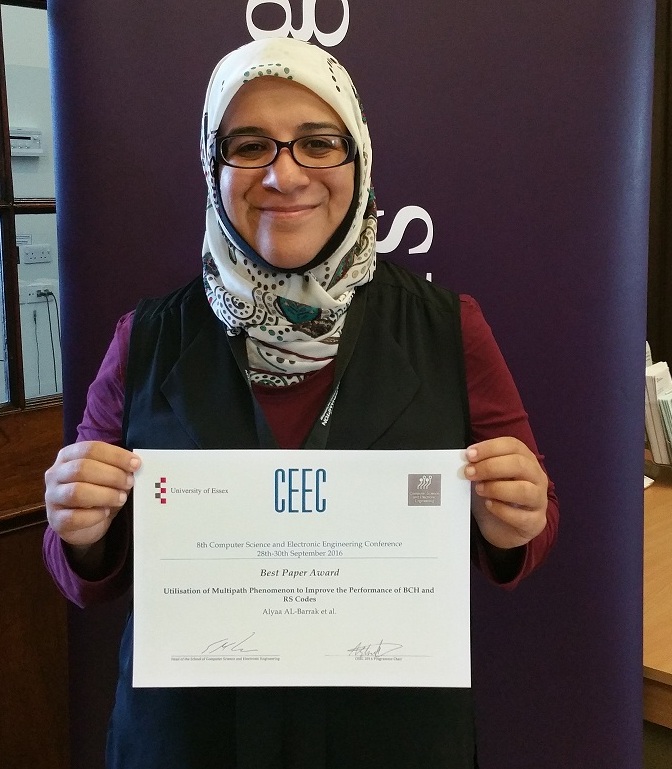
PhD student awarded best paper for her revolutionary research in wireless communication

Taken from: http://www.northampton.ac.uk/news/phd-student-awarded-best-paper-for-her-revolutionary-research-in-wireless-communication/


alyaareresearchpaper2
Not only was PhD student Alyaa Al-Barrak awarded the best paper at a recent conference, she has also had an offer for her paper to be published in a digital library, which hosts documents  from some of the world’s most highly cited publications in the engineering and computer science field.
The eighth Computer Science and Electronic Engineering Conference was held at the University of Essex and is a great opportunity for researchers to meet and network with peers in the same field. Alyaa presented her research paper on wireless communication and the errors that can occur due to noise, reflection, diffraction, shadowing, fading and in particular the multipath phenomenon and the most widely used technique to correct it. Her paper was awarded first place out of 93 other papers, which has led to an inclusion in the Institute of Electrical and Electronics Engineers’ Xplore Digital Library and an offer to publish an extended paper in a journal.
Alyaa said: “I was so pleased to be awarded the best paper at the conference and consider this a great achievement which has encouraged me to go further in this field. It has also provided me with evidence that I am delivering high-quality research and it will be a great addition to my CV.”
Robin Crockett, Alyaa’s Director of Studies, said: “Alyaa’s supervisors, Ali Al-Sherbaz, Triantafyllos Kanakis and myself are immensely proud of Alyaa. This is a major achievement and major recognition of Alyaa’s work from other researchers in the field of digital communications.”
Triantafyllos Kanakis, Lecturer in Computing, commented: “The solution proposed in this paper is revolutionary, drastically increasing the overall performance of a wireless system while saving expensive channel resources from retransmission.”
Ali Al-Shabaz, Senior Lecturer in Computing, commented: “The research outcomes of this work will have an impact on future technology and smart applications. The next stage of Alyaa’s research is expected to find more interesting results which will be worthy of publication in a journal with a high impact factor.”


All views and opinions are the author's and do not necessarily reflected those of any organisation they are associated with. Twitter: @scottturneruon

Tuesday, 11 October 2016

We can compute – undergrads scoop society awards

Taken from: http://www.northampton.ac.uk/news/we-can-compute-undergrads-scoop-society-awards/


Computing undergraduates from the University of Northampton have been recognised for their work with awards from two prestigious bodies.
Ten students received awards during the Northampton British Computing Society branch annual general meeting, which was held at Avenue Campus on Thursday 29 September.
Gongs were awarded by the British Computing Society (BCS) and HM Government Communications Centre (HMGCC)
Gary Hill, Head of Computing at the University, said: “I’m proud that our students have been recognised for their achievements from the British Computer Society and HMGCC.
“To have such an award win on their CVs will help to give them a competitive edge when they embark on their chosen careers.”
The award winners were:
BCS Best Computing 1st Year Award – Oloruntobi Abimbola Ayilara
BCS Best Computing Student Performance Prize – William Hurer-Mackay
BCS Best Business Computing 1st Year Award – Florin-Sebastian Ciobanu
BCS Best Business Computing Student Performance Prize – Souad McFarlane
HMGCC Best Dissertation Prize – Riyam Khalid Kareem Marjan
HMGCC Best Group Project Prize – Doaa Mundher Dalal Al-Midhatee, Gideon Awuah, Solomon Green, Ohood Hazim Sabr Sabr and Sana Ullah.


All views and opinions are the author's and do not necessarily reflected those of any organisation they are associated with. Twitter: @scottturneruon

Sunday, 29 May 2016

Computing Student Employability Skills Through STEM Outreach

Enhancing Computing Student Employability Skills Through Partnership Working in STEM Outreach - Springer:


Scott Turner
DOI: 10.1007/978-3-319-29166-6_10


Published in Software Engineering Education Going Agile Part of the series Progress in IS pp 67-71

Abstract

Student volunteering is growing in the UK and elsewhere, and there is an ongoing debate about whether it is really “self-evidently a ‘good thing’” or there is a greater need for reflection to determine whether this statement is true (Holdsworth and Quinn, Studies in Higher Education, 35(1), 113–127, 2010). This paper presents a personal reflection of Science, Technology, Engineering and Maths (STEM) volunteering as a potential route to increasing Computing student’s employability.


References


  • 1.
    STEMNet (2015) Science, Technology, Engineering and Mathematics Network [online] Available at: http://​www.​stemnet.​org.​uk/​ Accessed on: 24thJanuary 2015


  • 2.
    Sinclair J, Allen A, Davis L, Goodchild T, Messenger J, Turner S (2014) "Enhancing student employability skills through partnership working in STEM outreach; the University of Northampton approach " HEA STEM Annual Teaching and Learning Conference 2013: Enhancing the STEM Student Journey, University of Edinburgh, 30th April-1st May 2014


  • 3.
    Holdsworth, C., & Quinn, J. (2010). Student volunteering in English higher education. Studies in Higher Education, 35(1), 113–127.CrossRef


  • 4.
    Brewis, G., Russell, J., & Holdsworth, C. (2010). Bursting the bubble: Students, volunteering and the community. Research Summary.


  • 5.
    Junkbots (2015) Junkbots [online] Available at: http://​junkbots.​blogspot.​co.​uk/​ Accessed on: 24th January 2015.


  • 'via Blog this'

    Posting on the site does not imply endorsement in any way, by the blog owner or any organisations the blog owner is associated with.

    Monday, 9 May 2016

    Student perceptions of automated marking and feedback system in computing

    Ajit, S. and Dodds, J. (2016) 

    Student perceptions of automated marking and feedback system in computing. 

    Poster presented to:Higher Education Academy Annual STEM Conference 2016: Inspire to Succeed: Transforming Teaching and Learning in STEM, 

    East Midlands Conference Centre, Nottingham, 

    28-29 January 2016.


    Introduction
    The recent National Student Survey results once again (for over 10 years now) revealed low scores for assessment and feedback for taught courses in Higher Education. In this research project, we analysed and evaluated the effectiveness of improving a student’s learning experience using an automated marking and feedback system with a view to replace human marking of formative course assessments within computing. Can automated marking of formative assessments be used to enhance a student’s learning experience?


    If you'd like to find out more about Computing at the University of Northampton go to: www.computing.northampton.ac.uk. All views and opinions are the author's and do not necessarily reflected those of any organisation they are associated with

    Friday, 26 February 2016

    Student perceptions of different assessment modes in computer programming courses


    Suraj Ajit
    Assessment in HE Conference, Birmingham, UK, 23-24 June 2015


    Abstract
    Assessment is a process of measuring the extent to which students have fulfilled the expected learning outcomes for a course/module. There are many assessment strategies adopted by universities across the world for computer programming. They include written examination (closed book, open book), lab examination, multiple-choice/short-answer exams (paper or computer based), course work (or assignments) and oral examination. Again, the format, level and types of questions asked vary across universities. Assessment can take many forms, and it can be argued that the greater the diversity in the methods of assessment, the fairer, assessment is to students (Race 2007). The most effective form of assessment is one that appropriately examines the learning outcomes of the module. Assessment methods are also known to play an important role in how students learn (Brown 2004). The traditional assessment approach, in which one single written examination counts towards a student's total score, no longer meets new demands of programming language education (Wang, Li et al. 2012). Because computer programming is problem-solving oriented and very practical, the assessment of programming learning performance is challenging. The conventional assessment is not easy to be adapted to various new developments in computer programming education. This paper reports on the experience of adopting several assessment methods across programming modules for computing courses at the University of Northampton. In order to evaluate the assessment strategies from the students' perspective, a survey questionnaire was developed and distributed among a selected sample of final year computing course students. The paper discusses the results obtained from this survey. In particular, the paper compares the obtained results with that of other research performed in the same discipline as well as other disciplines. The key research questions the paper attempts to address are as follows:

    1. What is the most effective assessment method for programming modules from a students' point of view?

    2. How do student perceptions of computing (programming) assessments compare with that of other disciplines? Is programming any different?

    3. How do the student performances relate to their perceptions of the assessment methods?


    Citation:
    Ajit, S.
     (2015) Student perceptions of different assessment modes in computer programming courses. Other presented to:Assessment in HE Conference, Birmingham, UK, 24-25 June 2015.


    All views and opinions are the author's and do not necessarily reflected those of any organisation they are associated with

    Wednesday, 30 September 2015

    Computing students’ talents are recognised with society awards

    Originally posted on: http://www.northampton.ac.uk/news/computing-students-talents-are-recognised-with-society-awards

    • Wednesday 30th September 2015
      ​​Computing undergraduates from the University of Northampton have been recognised for their work with awards from a prestigious society.
      Ten students received awards during the Northampton British Computing Society branch annual general meeting, which was held at Avenue Campus on Tuesday 30 September.
      Gary Hill, Head of Computing and Immersive Technologies at the University, said: "I'm proud that our students are receiving awards for their achievements from the British Computer Society and HMGCC.
      "To have such an award win on their CVs will help to give them a competitive edge when they embark on their chosen careers."
      The award winners were:
      Best final year student dissertation – Jan Tucholka
      Most promising first year student – Ryan Sinfeld
      Best final year business computing student – Matt Jacobs
      Most promising first year business computing student – Yoanna Slavova.
      HMGCC (Her Majesty's Government Communications Centre) awards were also presented during the evening to the following:
      Best final year student – Matthew Houston De Cesare
      Best group project – Ali Obaid Hassan Al-Mahmood, Jonathan Dimmock, Ryan Edwards, Daniel Constantin Lupan and Deryn David Suttling.
      Computer Science at the University has just received two glowing endorsements in the Times and Sunday Times Good University Guide 2016 league tables.
      The subject was ranked in the top 10 for Teaching Quality and in the top 20 for Student Experience in the tables, which were published on September 20.

      Pictured, from left, are Ali Obaid Hassan Al-Mahmood, Jonathan Dimmock, Ryan Edwards, Daniel Constantin Lupan and Yoanna Slavova.​


    If you'd like to find out more about Computing at the University of Northampton go to: www.computing.northampton.ac.uk. All views and opinions are the author's and do not necessarily reflected those of any organisation they are associated with

    Friday, 1 May 2015

    Enhancing computing student employability skills through partnership working in STEM outreach.

    A paper was recently presented at the 11th China-Europe International Symposium of Software Engineering Education, 29-30 April 2015, Zwickau, Germany http://whz-cms-10.zw.fh-zwickau.de/bo/index_CEISEE.html


    Enhancing computing student employability skills through partnership working in STEM outreach.

    Scott Turner, Associate Professor, Department of Computing and Immersive Technologies, University of Northampton, Northampton, NN2 6JB, UK


    Abstract
    Student volunteering is growing in the UK and elsewhere, and there is an ongoing debate about whether it is really “self-evidently a ‘good thing’” or there is a greater need for reflection to determine whether this statement is true (Holdsworth and Quinn, 2010).  This paper presents a personal reflection of Science, Technology, Engineering and Maths (STEM) volunteering as a potential route to increasing Computing student’s employability.
    This paper looks at an approach at the University of Northampton that involves:
    • ·         Linking but not combining a local STEM volunteering scheme to the National STEM Volunteers (STEMNet 2015)
    • ·         Creation of a STEM Steering Group that has representation across all parts of the university.

    Three brief case studies of computing student volunteers at different stages will be presented and culminate with a personal reflection based on observations over a ten year period.


    References


    • Brewis, G., Russell, J., & Holdsworth, C. (2010). Bursting the bubble: Students, volunteering and the community. Research Summary.


    • Junkbots (2015) Junkbots [online] Available at: http://junkbots.blogspot.co.uk/ Accessed on: 24th January 2015.

    • Sinclair J, Allen A, Davis L, Goodchild T, Messenger J, Turner S (2014) "Enhancing student employability skills through partnership working in STEM outreach; the University of Northampton approach " HEA STEM Annual Teaching and Learning Conference 2013: Enhancing the STEM Student Journey, University of Edinburgh, 30th April-1st May 2014

    • STEMNet (2015) Science, Technology, Engineering and Mathematics Network [online] Available at: http://www.stemnet.org.uk/ Accessed on: 24th January 2015.


    Scott is also on the International Programme committee (http://whz-cms-10.zw.fh-zwickau.de/bo/CEISEE_ProgComm.html)  and was a session chair for a paper session.


    If you'd like to find out more about Computing at the University of Northampton go to: www.computing.northampton.ac.uk. All views and opinions are the author's and do not necessarily reflected those of any organisation they are associated with

    Friday, 6 March 2015

    Towards the Development of a Diet Suggesting Application

    MSc Student Work


    Towards the Development of a Diet Suggesting Application 
    Rajamanikkam Vikneswaran 

    Abstract
    One of the things which mainly impact a person’s health is his or her diet. Therefore it is important to have a healthy diet. Diet applications and websites are tools which are meant to help individuals to have healthy balanced diets. There are a number of diet applications and websites out in the market. Based on the diet domain and the diet applications in the market, the limitations in the presently available diet applications have been identified. Further, a set of features have been identified as very useful ones for users, if implemented in diet applications. 

    Based on this information, a diet suggesting application was built. This application attempts to address the main limitations in the presently available diet applications. Then the application is tested by the researcher and then was evaluated by users. 

    This dissertation paper documents all the stages of this process. It provides background information on diet domain, limitations in the current applications and the suggested features to address these limitations. It then explains how the limitations in the presently available diet applications have been addressed technically, in the new application. It further discusses on how the new application was designed and developed, why it was developed in the way it was developed. Then it discusses how the application was tested and evaluated and the results of testing and evaluation. Finally it discusses about overall outcomes of the project and next stages of the application


    If you'd like to find out more about Computing at the University of Northampton go to: www.computing.northampton.ac.uk. All views and opinions are the author's and do not necessarily reflected those of any organisation they are associated with

    Thursday, 2 October 2014

    Hot House Student Consultancy helps antiques business establish online presence

    Taken from: http://www.northampton.ac.uk/news/hot-house-student-consultancy-helps-antiques-business-establish-online-presence published Tuesday 23rd September 2014

    • The University of Northampton's student consultancy service Hot House recently helped a new antiques business establish itself within the sector.
      Hot House student consultants deliver a cost effective support solution to small and medium sized businesses across the region. They provide support to clients that might otherwise be unable to access commercial consultancy services, while offering students the opportunity to engage in paid activity that directly enhances their student experience and future employability prospects.
      In 2013, Hot House was approached by a successful retired entrepreneur Rosalba Brooks to assist in a new project. Rosalba wanted to set up a new business in the antiques sector selling her vast collection and buying new commodities.
      Hot House met with Rosalba and formulated a plan to create a brand, a website and various event marketing materials for the new business: Rosalba Antiques.  The team contacted contacted Dr Mark Johnson, Deputy Head of Computing within the University's School of Science and Technology who recommended a 2nd year student named Matthew (Matty) De Cesare who had demonstrated a flare for both design and software engineering. Matty signed up to Hot House and quickly impressed the team and the client with his skills, working from brief to create a logo concept and a highly complex web site from just code. 

    To read more:  http://www.northampton.ac.uk/news/hot-house-student-consultancy-helps-antiques-business-establish-online-presence

    Wednesday, 1 October 2014

    Student winners 2014

    Students within Computing at the University of Northampton continue to shine. Here is a list of the prize winners for 2013-2014. Prizes are sponsored by 

    Her Majesty's Government Communications Centre and BCS Northampton


    Winner of BCS The Chartered Institute for IT - Best Technical Computing 1st Year Award. 
    Danial Lupan

    Winner of BCS The Chartered Institute for IT Best Student Performance Prize
    Jason Peel

    Winner of BCS The Chartered Institute for IT - Best Business Computing Student Award. 
    Glen Weston

    Winner of BCS The Chartered Institute for IT Best Student Business Computing Performance Prize
    Tafadzwa Chigutsa

    Winner of the HM Government Communication Centre (HMGCC) Best Dissertation Prize
    Christopher Read

    Winner of the Best Group Project Prize from HM Government Communication Centre (HMGCC)
    • Sultan  Saleh
    • Washington         Bhebhe
    • Heydon         Hancox
    • Jamie         Humphries
    • Ameen         Abdel Hai 

    Congratulations

    Now with photos 
    http://northampton.bcs.org/dsp_get_gallery.php?gallery_id=20140930.php


    Links to the Sponsors


    Tuesday, 24 June 2014

    Preprint: Computer Science Courses Using Laptops

    A preprint of paper to be publish in the next edition the journal Innovation in Teaching and Learning in Information and Computer Sciences (ITALICS) is now available at http://journals.heacademy.ac.uk/doi/abs/10.11120/ital.2014.00011

    Computer Science Courses Using Laptops

    Gary Hill, Espen Svennevik and Scott Turner
    Department of Computing & Immersive Technologies, University of Northampton, UK
    Corresponding author: Scott Turner, Department of Computing & Immersive Technologies, University of Northampton, UK Email: scott.turner@northampton.ac.uk, Phone: +44 (0) 1604 893028

    Abstract

    Traditionally computer sciences courses have been taught using laboratories full of expensive desktop computers. Although this approach may have been valid in the 80, 90s and even the early part of this decade, this paper suggests that buying, maintaining and replacing laboratories full of computers is no longer required. This paper raises the issues associated with attempting to use laptops – as thin/thick clients using virtual machines – to deliver the computer science curriculum and offers potential solutions that, in some cases, may make computer science courses at such ‘brave’ institutions more appealing.


    Read More: http://journals.heacademy.ac.uk/doi/abs/10.11120/ital.2014.00011


    Friday, 2 May 2014

    Enhancing student employability skills through partnership working in STEM outreach; the University of Northampton approach.

    A paper has recently been present at HEA STEM Annual Teaching and Learning Conference 2013: Enhancing the STEM Student Journey, University of Edinburgh, 30th April-1st May 2014


    Enhancing student employability skills through partnership working in STEM outreach; the University of Northampton approach.
    John Sinclair*, Stuart Allen†, Linda Davis, Trish Goodchild, Julie Messenger#, Scott Turner

    University of Northampton, St George’s Avenue, Northampton, NN3 3AF.
    †University of Northampton, Boughton Green Road, Northampton.  NN2 7AL.
    # Leicester Educational Business Company, Ashcroft House, Ervington Court,  Meridian Business Park. Leicester LE19 1WL
    *author for correspondence


    For over a decade, University of Northampton staff and students have delivered successful STEM outreach activities, master classes and co-working opportunities to learners in schools and FE colleges.  In addition, the University works with the local STEMNET contract holder to gain national recognition for staff and students STEM Ambassadors and recognises STEM Ambassadors through awards (staff and student) as part of its annual celebration of volunteer achievement.  Both developments derive from a culture of empowering students as partners and enhancing the student journey.

    The University has developed a co-ordinated programme of training and events to empower students and staff to engage with school and community outreach.  A cross-University STEM Steering Group (SSG) which features both management and grass roots-level representation from the across the University (Science and Technology, Health, Education, the Arts and its Centre for Employability and Engagement) manages the activities, including recruiting representation from the student body.  As such, SSG is uniquely well-placed to champion STEM activities across the University and to make these available to the wider community.  Local schools are able to access inspirational science activities, whilst University students gain employability-related skills in leadership, communication, project-delivery and self-motivation and staff gain valuable CPD.  Students also identify more strongly with the University.  The total package plays a major role in contributing to University aspirations in widening participation and is hugely popular with participants.  This paper will outline the project and will showcase the positive enhancements which it offers to University of Northampton students and school participants.


    Conference details HEA STEM Annual Teaching and Learning Conference 2013: Enhancing the STEM Student Journey, University of Edinburgh, 30th April-1st May 2014

    Friday, 16 August 2013

    BSc Computing: Sample student robot videos

    Some example videos of student work with robots

     First year problem-solving exercise


    Third year AI assignment