Computing within Northamptonshire is dynamic with interests in many aspects of computing and engineering. All views are the author and the site is the property of the author.
Showing posts with label Communication. Show all posts
Thursday, 8 June 2017
Changing minds: multitasking during lectures.
1.Changing minds: multitasking during lectures.
Coulter-Smith, L. (2017)
Paper presented at 13th China Europe International Symposium on Software Engineering Education (CEISEE) held in Athens, Greece, 24-25 May 2017
Abstract: Multitasking students is a common topic amongst academics. Many studies focus on how students multitask while this study investigates why students multitask in formal lectures. A questionnaire was used to discover student perceptions around multitasking amongst computing students. The results indicate most students are adequately motivated to improve their multitasking behaviour if it influences their grades. Results show that most students claimed boredom as a significant reason for multitasking in class. This study suggests we inform students about the effects of multitasking as it relates to their academic achievement.
To find out more click here.
All views and opinions are the author's and do not necessarily reflected those of any organisation they are associated with. Twitter: @scottturneruon
Tuesday, 25 October 2016
PhD student awarded best paper for her revolutionary research in wireless communication
Taken from: http://www.northampton.ac.uk/news/phd-student-awarded-best-paper-for-her-revolutionary-research-in-wireless-communication/
All views and opinions are the author's and do not necessarily reflected those of any organisation they are associated with. Twitter: @scottturneruon

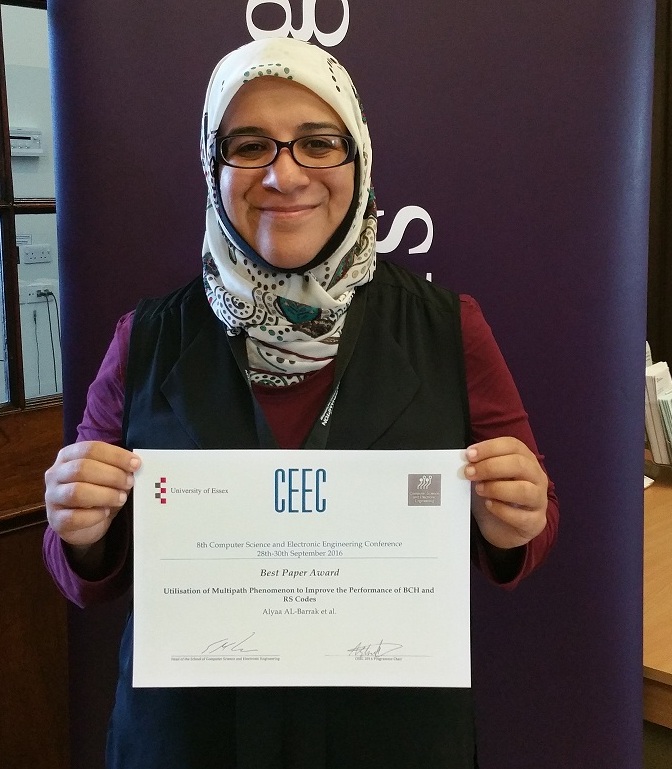
Not only was PhD student Alyaa Al-Barrak awarded the best paper at a recent conference, she has also had an offer for her paper to be published in a digital library, which hosts documents from some of the world’s most highly cited publications in the engineering and computer science field.
The eighth Computer Science and Electronic Engineering Conference was held at the University of Essex and is a great opportunity for researchers to meet and network with peers in the same field. Alyaa presented her research paper on wireless communication and the errors that can occur due to noise, reflection, diffraction, shadowing, fading and in particular the multipath phenomenon and the most widely used technique to correct it. Her paper was awarded first place out of 93 other papers, which has led to an inclusion in the Institute of Electrical and Electronics Engineers’ Xplore Digital Library and an offer to publish an extended paper in a journal.
Alyaa said: “I was so pleased to be awarded the best paper at the conference and consider this a great achievement which has encouraged me to go further in this field. It has also provided me with evidence that I am delivering high-quality research and it will be a great addition to my CV.”
Robin Crockett, Alyaa’s Director of Studies, said: “Alyaa’s supervisors, Ali Al-Sherbaz, Triantafyllos Kanakis and myself are immensely proud of Alyaa. This is a major achievement and major recognition of Alyaa’s work from other researchers in the field of digital communications.”
Triantafyllos Kanakis, Lecturer in Computing, commented: “The solution proposed in this paper is revolutionary, drastically increasing the overall performance of a wireless system while saving expensive channel resources from retransmission.”
Ali Al-Shabaz, Senior Lecturer in Computing, commented: “The research outcomes of this work will have an impact on future technology and smart applications. The next stage of Alyaa’s research is expected to find more interesting results which will be worthy of publication in a journal with a high impact factor.”
All views and opinions are the author's and do not necessarily reflected those of any organisation they are associated with. Twitter: @scottturneruon
Monday, 4 July 2016
SlideAcross: novel distributing method for on chip multi-processor data
Zong, W., Wang, L., Xu, Q. and Opoku Agyeman, M. (2016) SlideAcross: a low-latency adaptive router for chip multi-processor.In: Proceedings of Euromicro DSD/SEAA 2016. Cyprus: IEEE. (Accepted)
Abstract
The non-uniform distributed traffic of chip multiprocessor (CMP) demands an on-chip communication infrastructure which is able to avoid congestion under high traffic conditions while possessing minimal pipeline delay at low load conditions. In this paper, we propose a low-latency adaptive router with a low-complexity single-cycle bypassing mechanism to meet the communication needs of CMPs. This router transmits a flit using dimension-ordered routing (DoR) in the bypass datapath at low loads. When the output port required intra-dimension bypassing is not available, the packet is routed adaptively to avoid congestion. The router also has a simplified virtual channel allocation (VA) scheme that yields a nonspeculative low-latency pipeline. By combining the low-complexity bypassing technique together with adaptive routing, the proposed router architecture can achieve low-latency communication under various traffic loads. Simulation shows that proposed router can reduce applications’ execution time by 16.9% in average compared to low-latency router SWIFT
To read more go to SlideAcross: a low-latency adaptive router for chip multi-processor.
If you'd like to find out more about Computing at the University of Northampton go to: www.computing.northampton.ac.uk. All views and opinions are the author's and do not necessarily reflected those of any organisation they are associated with
Abstract
The non-uniform distributed traffic of chip multiprocessor (CMP) demands an on-chip communication infrastructure which is able to avoid congestion under high traffic conditions while possessing minimal pipeline delay at low load conditions. In this paper, we propose a low-latency adaptive router with a low-complexity single-cycle bypassing mechanism to meet the communication needs of CMPs. This router transmits a flit using dimension-ordered routing (DoR) in the bypass datapath at low loads. When the output port required intra-dimension bypassing is not available, the packet is routed adaptively to avoid congestion. The router also has a simplified virtual channel allocation (VA) scheme that yields a nonspeculative low-latency pipeline. By combining the low-complexity bypassing technique together with adaptive routing, the proposed router architecture can achieve low-latency communication under various traffic loads. Simulation shows that proposed router can reduce applications’ execution time by 16.9% in average compared to low-latency router SWIFT
To read more go to SlideAcross: a low-latency adaptive router for chip multi-processor.
If you'd like to find out more about Computing at the University of Northampton go to: www.computing.northampton.ac.uk. All views and opinions are the author's and do not necessarily reflected those of any organisation they are associated with
Sunday, 15 February 2015
Chaos based cryptography for voice encryption in wireless communication
Chaos based cryptography for voice encryption in wireless
communication
Sadkhan, S., Al-Sherbaz,
A. and Mohammed, R.
International Conference on Electrical, Communication,
Computer, Power, and Control Engineering (ICECCPCE).
Iraq: IEEE.
pp. 191-197
Abstract
The vast growths in mobile and wireless
applications would contain lacks of using suitable security concepts during the
development process which worries the information security research community.
This paper reviews most of the encryption techniques which adopt chaos based
cryptography, and illustrates the used of chaos based voice encryption
techniques in wireless communication as well. The review in this paper
summarized the traditional and modern techniques of voice/speech encryption and
demonstrated the feasibility of adopting chaos based cryptography for in
wireless communications.
citation: Sadkhan, S., Al-Sherbaz, A. and Mohammed, R. (2015) Chaos based cryptography for
voice encryption in wireless communication. In: International Conference on
Electrical, Communication, Computer, Power, and Control Engineering (ICECCPCE). Iraq:
IEEE. pp. 191-197
If you'd like to find out more about Computing at the University of Northampton go to: www.computing.northampton.ac.uk. All views and opinions are the author's and do not necessarily reflected those of any organisation they are associated with
Tuesday, 25 June 2013
Machine to Machine Communication
The following paper is to be presented at Global Interactions, Annual Research Conference 2013 Postgraduate Research Degree Students and Early Career Researchers. University of Northampton 27th June 2013.
Compressive Sensing of Machine to Machine Communication Terminals as a Means of Enhancing their Energy Efficiencies (M2M Green Communications).
Sylvester Ajah
School of Science and Technology,
Computing and Immersive Technology Division
Abstract
Energy efficiency of the machine to machine (M2M) communications terminals is one of the major design goals of the M2M networks, going by the fact that there are over 50 billion of M2M communication devices to be deployed into the network by year 2020. The stakeholders in the M2M communications have observed that it will be environmental and economic catastrophic to deploy M2M communication terminals without solving the energy inefficiencies associated with wireless devices that are expected be used for M2M communications.
This research will examine compressive sensing of machine to machine communication terminals in collaboration with energy synchronisation techniques as the means for actualizing the over a decade life span of M2M communication terminals.
Supervisors
Dr Ali Al-Sherbaz
Prof. Phil Picton
Dr Scott Turner
Wednesday, 3 August 2011
development of Ad-Hoc Robot Networks
Neeraj Jalan
Subscribe to:
Posts (Atom)


