Showing posts with label school of science and technology. Show all posts

Friday, 5 February 2016

Robot investment in Students

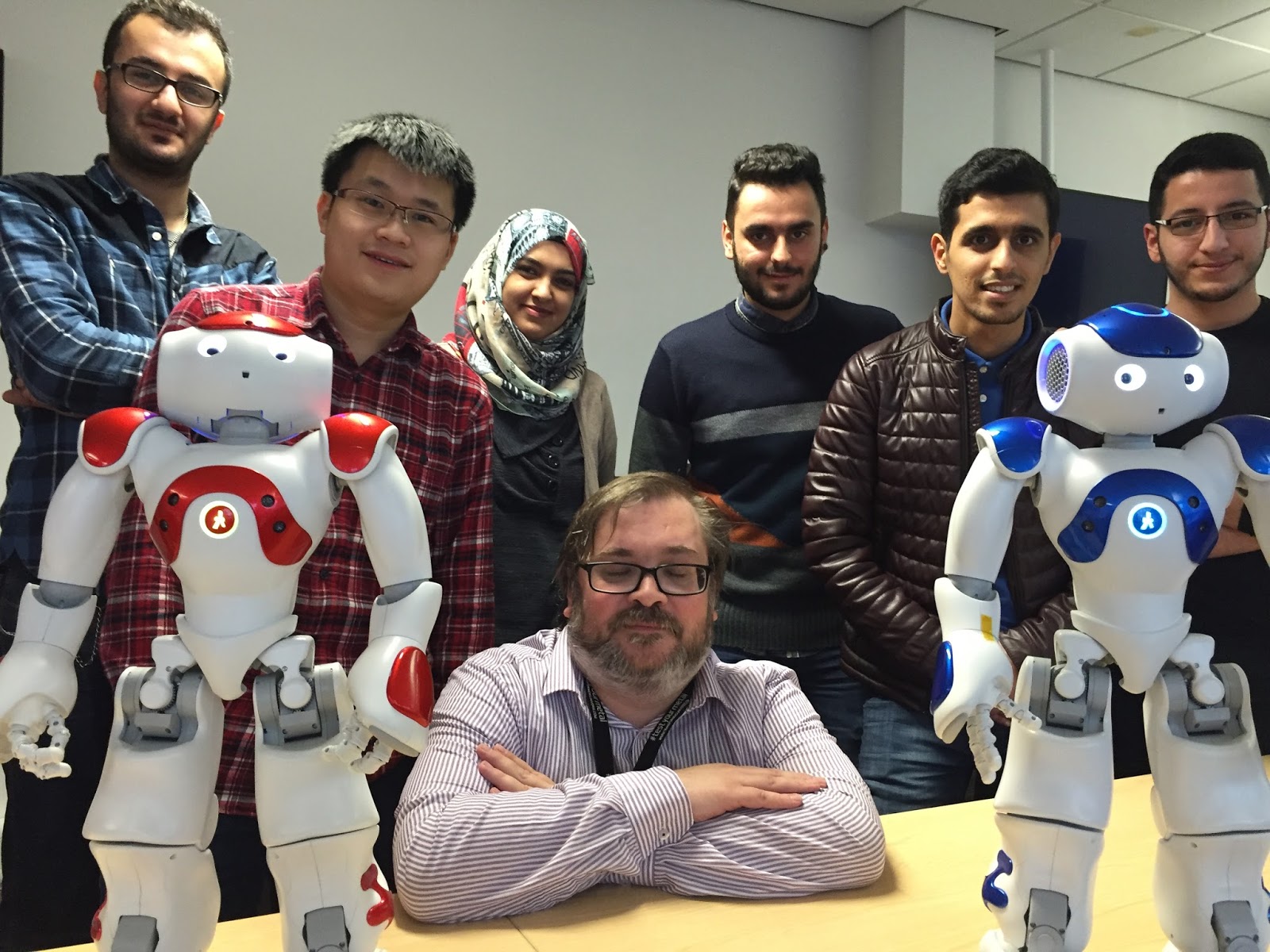
Just a short post about students and robots.  A recent investment in robots by the University of Northampton with matched from HEFCE has improved the capability of what can be taught. The larger robots, NAO robots from Aldebaran robotics, now enable the students to experience first-hand social robotics, which is predicted to be a growth area in robotics. The smaller robots are a few of the Picobot 2s, swarm robots from 4Tronix, adding  this capacity to the computing courses.

To read more about the overall investment click here.



All views and opinions are the author's and do not necessarily reflected those of any organisation they are associated with

Wednesday, 24 December 2014

primary robot design questionnaire

An undergraduate dissertation student is looking for help. James is a computing student looking at robot designs for primary education towards his dissertation and as part of the wider Junkbots project, and the working going on in both the Department of Computing and Immersive Technologies, and School of Education on Physical Computing at the University of Northampton.

The short questionnaire can be found at http://t.co/zdomXnW2Qe and is aimed at gathering a variety of responses from both current Teachers, Students of Education and from anyone with knowledge of programming teaching methods in both Key Stage 1 and 2. He is planning to create a product which aims to teach programming methods and practices based on the current and new national curriculum.


If you'd like to find out more about Computing at the University of Northampton go to: www.computing.northampton.ac.uk. All views and opinions are the author's and do not necessarily reflected those of any organisation they are associated with.

Thursday, 2 October 2014

Hot House Student Consultancy helps antiques business establish online presence

Taken from: http://www.northampton.ac.uk/news/hot-house-student-consultancy-helps-antiques-business-establish-online-presence published Tuesday 23rd September 2014

  • The University of Northampton's student consultancy service Hot House recently helped a new antiques business establish itself within the sector.
    Hot House student consultants deliver a cost effective support solution to small and medium sized businesses across the region. They provide support to clients that might otherwise be unable to access commercial consultancy services, while offering students the opportunity to engage in paid activity that directly enhances their student experience and future employability prospects.
    In 2013, Hot House was approached by a successful retired entrepreneur Rosalba Brooks to assist in a new project. Rosalba wanted to set up a new business in the antiques sector selling her vast collection and buying new commodities.
    Hot House met with Rosalba and formulated a plan to create a brand, a website and various event marketing materials for the new business: Rosalba Antiques.  The team contacted contacted Dr Mark Johnson, Deputy Head of Computing within the University's School of Science and Technology who recommended a 2nd year student named Matthew (Matty) De Cesare who had demonstrated a flare for both design and software engineering. Matty signed up to Hot House and quickly impressed the team and the client with his skills, working from brief to create a logo concept and a highly complex web site from just code. 

To read more:  http://www.northampton.ac.uk/news/hot-house-student-consultancy-helps-antiques-business-establish-online-presence

Thursday, 31 July 2014

Lecturer in Computing (Media Technology)

Lecturer in Computing (Media Technology)

The University of Northampton

Location Avenue Campus
Documents
The School is organised into three Programme Areas/Departments.  This post will be located in the Computing and Immersive Technologies department. The area has a strong technical computing teaching and learning profile at under and postgraduate levels, and we now seek to promote and develop our technical MEng/MSc/BEng/BSc Computing programmes.  As such, we require a lecturer appointment to help support and develop the work within the Computing and Immersive Technologies disciplinary area and more particularly Media Technology to:
  • Programming and evaluation of media related applications.
  • Implementing and evaluation of media manipulation techniques
  • Media manipulation and compression techniques.
  • Developing multimedia systems in a third generation computer language.
The successful candidate will be expected to provide leadership and management in the development of their discipline and to lecture at both under and postgraduate levels. There is also an expectation that the successful applicant will contribute to Research, Knowledge Transfer and/or Consultancy within the Department of Computing & Immersive Technologies. Some International travel may be expected for between 1 and 2 weeks per year.
Interview Date: 5 September 2014
The University of Northampton as an employer strives to achieve diversity among its staff, which reflects the communities it serves. 

Monday, 9 June 2014

Immersive technology devices and field work: Oculus Rift


Who is your project team? Scott Turner and Naomi Holmes, School of Science and Technology, Adel Gordon, Learning Technology
How much funding did you receive? £1,200

Poster available at: 
http://slidesha.re/1kvvUuX 
What is your project? The aim was to investigate the potential use and the student experiences of using virtual reality (Oculus Rift) devices for field trips. Virtual reality field trips have been used by a number of HE institutions for a number of reasons
  • To give students the opportunity to prepare for a ‘real-life’ field trip (risk assessments, kit selection, project preparation etc)
  • To allow students to reflect on a recent field trip
  • To provide an additional field trip experience without incurring extra costs for the student or institution
  • To improve accessibility to field work experiences
  • To allow distance learning students to participate in field work
Computer-based (virtual reality) field trips have in the past been perceived negatively by students, often due to a poor representation of reality. Currently these field trips take place in 3D environments on a 2D computer screen. There has been an emphasis on enhancing the realism of these virtual field trips.

The recent release of Oculus Rift, a relatively low-cost virtual-reality headset which tracks the user’s head movements, allowing users to ‘walk through’ a virtual landscape immersively, offers an opportunity to further improve the virtual reality field trip experience.

Thirteen Environmental and Geographical Sciences student volunteers tested the Oculus Rift. The students used the Oculus Tuscany Demo software to work around a landscape, spending between 10 and 30 minutes in the landscape. No students had used an Oculus Rift previously. After using the devices they fed back through a questionnaire their views on its use from a learner's perspective.

Do you have any outcomes you can report? From the questionnaires:

  • The students all saw the virtual reality as beneficial only if used alongside or in addition to actual field trip experiences
  • Motion sickness was a common problem of using the devices and so limits the time it can be used
  • Overall the response was positive for the testers
  • Other applications such as studying plant structure, looking at past environments and cell structure were suggested by the students
The work has been disseminated. The results were discussed and participants had a chance to try the Oculus Rifts in a workshop at the recent Northampton Learning and Teaching Conference - Northampton 2018: Planning, Designing and Delivering Student Success.

Friday, 6 June 2014

The Mystery of The Hanging Garden of Babylon

It is not usually what you thinking of as related computing but the team within the Department of Computing and Immersive Technologies, University of Northampton have wide and varied interests. Here is one example:


Wednesday, 26 March 2014

Computing Seminar: Web Sustainability


Description:
The presentation discusses two projects looking at the questions:
- What are some of the options for a publicly funded web resources when the money is no longer there to host it?
- What could you do if there is no money there in the first place? An example site is shown with this constraint.


Presented 26th March 2014, Department of Computing and Immersive Technologies, School of Science and Technology, University of Northampton, UK as part of the Computing Research Seminar Series.

Citation:
Turner, Scott (2014): Web sustainability. figshare. 
http://dx.doi.org/10.6084/m9.figshare.1005663


Contact: scott.turner@northampton.ac.uk 

Thursday, 26 December 2013

Computing Publication list including 2013

The up-to-date publication list, including 2013 papers, for Department of Computing and Immersive Technology, School of Science and Technology, University of Northampton is now available at: http://computingnorthampton.blogspot.co.uk/p/publication-list-university-of.html


Examples from 2013
For more details about the Research activities within the Department of Computing and Immersive Technologies contact Dr Scott Turner on scott.turner@northampton.ac.uk

Friday, 30 August 2013

Associate Professor in Computing

Starting 1st September 2013 the Department of Computing and Immersive Technologies for three years will have an Associate Professor.

Dr Scott Turner has been seconded as Associate Professor majoring in Teaching and Learning and minoring in Research and Enterprise


Fellowships, Ambassador Roles, Professional Bodies


Sample Publications (ORCID record)

  • Hill G and Turner S (2013) Electronic Online Marking Of Software Assignments (EOMOSA) CEISIE 2013 13th -14th May 2013 Milan
  • Turner S (2013) Junkbots HEA STEM: Annual Learning and Teaching Conference 2013: Where practice and pedagogy meet 17 Apr 2013 - 18 Apr 2013
  • Al-Khalil AB, Al-Sherbaz A, Turner S (2013) Enhancing the Physical Layer in V2V Communication Using OFDM – MIMO Techniques 14th Annual PostGraduate Symposium on The Convergence of Telecommunications, Networking and Broadcasting (PGNET 2013) in Liverpool 24-25th June 2013.
  • Turner, S (2012) Case Studies in Web Sustainability Ariadne No 70 ISSN: 1361-3200
  • Maunder, R., Turner, S., Sneddon, S. and Crouch, A. (2012) Editorial. Enhancing the Learner Experience in Higher Education. 4(1), pp. 1-2. 2041-3122.
  • Turner, S. and Al-Sherbaz, A. (2012) What's the problem with problem-solving? Seminar Presentation presented to: Insights into the future of learning and teaching at Northampton, University of Northampton, 3rd December 2012.
  • Kariyawasam K., A., Turner S., Hill G. (2012) "Is it Visual? The importance of a Problem Solving Module within a Computing course", Computer Education, Volume 10, Issue 166, May 2012, pp. 5-7, ISSN: 1672-5913. 
  • Hill G., Turner S. (2012) "Referencing within Code in Software Engineering Education!", Computer Education, Volume 10, Issue 166, May 2012, pp. 1-4, ISSN: 1672-5913.
  • Turner S (2011) "Enhancing the Sustainability of the East Midlands Knowledge Network: final Report " [online] URL:http://ie-repository.jisc.ac.uk/563/2/EMKN_final_report_output4337.doc accessed on: 6/12/2011.
  • Turner S (2011) Neural Nets Robotics Workshop. Bot Shop! University of Derby, 28th October 2011.
  • Hill G, Turner S (2011) Chapter 7 Problems First Software Industry-Oriented Education Practices and Curriculum Development: Experiences and Lessons edited by Drs. Matthew Hussey, Xiaofei Xu and Bing Wu. ISBN: 978-1609607975 IGI Global June 2011
  • Hill, G, Svennevik E, Turner S (2011) "Green Computer Science Courses. No more labs full of computers, we're going mobile!" The 7th China - Europe International Symposium on Software Industry Oriented Education (CEISIE 2011), University of Northampton 23-24th May 2011
  • Turner S (2011) "Junkbots" The 7th China - Europe International Symposium on Software Industry Oriented Education (CEISIE 2011), University of Northampton 23-24th May 2011
  • McGovern K, Mothersole P, Turner S (2011) "Influencing students' construction of personalised concept maps through the use of query expansion (QE) searching of the World Wide Web" Learning Global, University of Northampton 11th May 2011
  • Kariyawasam K and Turner (2011) "Is it Visual? problem solving evaluation" Learning Global,University of Northampton 11th May 2011
  • Goodchild T, Dravid R, Turner S (2011) "Mind the Gender Gap - Reflections on addressing gender diversity in Computing and Engineering" Learning Global,University of Northampton 11th May 2011
  • Wang, Y., Picton, P., Turner, S. and Attenburrow, G (2011) The Subjective Measurement of Leather Handle by Descriptive Sensory Analysis, Journal of the American Leather Chemists Association, Apr 2011 pp 134-139
  • Wang, Y., Picton, P., Turner, S. and Attenburrow, G (2011) Predicting Leather Handle like an Expert Artificial Neural Networks, Applied Artificial Intelligence, Volume 25, Issue 2 February 2011 , pages 180 - 192 ISSN: 0883-9514DOI:10.1080/08839514.2011.545218 pp 180-192.
  • Zhao F, Turner S, Hill G, Dravid R, Zhang Y (2010) A Virtual Environment Training System for Haptic Laparoscopic Surgery 16th International Conference on Automation and Computing, University of Birmingham, Birmingham, UK, 11 September 2010
  • Turner S and Hill G (2010) "Innovative use of Robots and Graphical Programming in Software Education" Computer Education Ser. 117 No. 9 pp 54-57 ISSN: 1672-5913
  • Turner S (2010) "PowerPoint is just the start" Learning Dialogues: Learning and Teaching Conference, University of Northampton 13th May 2010
  • Turner S (2010) "Initial Experience of using Audio Feedback" Learning Dialogues: Learning and Teaching Conference, University of Northampton 13th May 2010
  • Turner S(2009) " PowerPoint, but what else?"10th Higher Education Academy-ICS Conference, University of Kent, 24-27th August 2009, pp 151 ISBN 978-0-9559676-6-5
  • Turner S (2009)"Initial experience of using audio feedback for general assignment feedback" A Word In Your Ear 2009 Sheffield Hallam University, 18 December 2009 pg 12
  • Turner S, Hill G, Adams J (2009) "Robots in problem solving in programming" 9th 1-day Teaching of Programming Workshop, University of Bath, 6th April 2009.
  • Turner S (2009) "Tiddlywikis for student developed resources" Transitions: Teaching and Learning Conference 13th May 2009 University of Northampton.
  • Turner S and Hill G(2008) "Robotics within the Teaching of Problem-Solving" ITALICS vol. 7 No. 1 June 2008 pp 108-119 ISSN 1473-7507 DOI:10.11120/ital.2008.07010108
  • Turner S (2008) "TiddlyWikis for Student Developed Resources" 9th Higher Education Academy-ICS Annual Conference, Liverpool Hope University, 26th August - 28th August 2008. pp. 192 ISBN 978-0-9559676-0-3.
  • Turner S and Adams J (2008) "Robots and Problem Solving" 9th Higher Education Academy-ICS Annual Conference, Liverpool Hope University, 26th August - 28th August 2008. pp. 14 ISBN 978-0-9559676-0-3.
  • Minai, A, Turner S, and Hill. G (2008) "Motivational Differences in Learning Internet Programming Between Arts and Computing Students" 9th Higher Education Academy-ICS Annual Conference, Liverpool Hope University, 26th August - 28th August 2008. pp. 197 ISBN 978-0-9559676-0-3.
  • Adams, J. and Turner, S., (2008) Problem Solving and Creativity for Undergraduate Computing and Engineering students: the use of robots as a development tool Creating Contemporary Student Learning Environments 2008, Northampton, UK.
  • Adams, J. and Turner, S., (2008) Problem Solving and Creativity for Undergraduate Engineers: process or product? International Conference on Innovation, Good Practice and Research in Engineering Education 2008, Loughborough, UK.
  • Adams, J., Turner, S., Kaczmarczyk, S., Picton, P. and Demian, P.,(2008). Problem Solving and Creativity for Undergraduate Engineers: findings of an action research project involving robots International Conference on Engineering Education ICEE 2008, Budapest, Hungary
  • Turner S and Hill G(2007) Robots in Problem-Solving and Programming 8th Annual Conference of the Subject Centre for Information and Computer Sciences, University of Southampton, 28th - 30th August 2007, pp 82-85 ISBN 0-978-0-9552005-7-1
  • Wang, Y., Picton, P, Turner, S. and Attenburrow, G.,(2007) A Neural Network Approach to Investment the Objective and Subjective Measurements of Leather Handle, in Proceedings of the AI-METH, 2007: p. 241-246.
  • Turner S (2007) Developing problem-solving teaching material based upon Microsoft Robotics Studio. 8th Annual Conference of the Subject Centre for Information and Computer Sciences, University of Southampton, 28th - 30th August 2007 pp 151 ISBN 0-978-0-9552005-7-1
  • Turner S (2007) Developing problem-solving teaching materials based upon Microsoft Robotics Studio. Innovative Teaching Development Fund Dissemination Day 1st March 2007 Microsoft:London
  • Salamaliki-Simpson, R., Kaczmarczyk, S., Picton, P., Turner, S(2006), The Vibration Study of Non-Linear Interactions in a Moving Elevator Car-Suspension Rope System. Proceedings of the Symposium on the Mechanics of Slender Structure (MoSS 2006), 28 - 29 September 2006, Northampton , Paper #10, CD-ROM.
  • Salamaliki-Simpson R, Kaczmarczyk S, Picton P, Turner S (2006) Proceedings of the 6th International Conference on Modern Practice in Stress and Vibrational Analysis, Bath U.K
  • Salamaliki-Simpson R, Kaczmarczyk S, Picton P, Turner S (2006) Non-Linear Modal Interactions in a Suspension Rope System with Time-Varying Length Journal of Applied Mechanics and Materials Vol. 5-6 pp 217-224 ISSN 1660-9336
  • Turner S and Hill G (2006) The Inclusion Of Robots Within The Teaching Of Problemsolving: Preliminary Results Proceedings of 7th Annual Conference of the ICS HE Academy Trinity College, Dublin, 29th - 31st August 2006 Proceedings pg 241-242 ISBN 0-9552005-3-9
  • Prince K, Campbell J, Picton P, Turner S (2005) A computational model of Acute Pain International Journal of Simulation: Systems, Science and Technology Vol. 6 No. 9 pp 1-10 ISSN 1473-8031.
  • Prince K, Campbell J, Picton P, Turner S (2005) A computational model simulating how pain modulation can occur through transcutaneous electrical nerve stimulation (TENS) International Conference on Computer Science & Information Systems Athens, Greece, June 15-18, 2005
  • Salamaliki-Simpson, R., Kaczmarczyk, S., Picton, P., Turner, S.(2005) The Dynamics and Vibration of an Elevator Car- Suspension Rope System. Proceedings of the Twelfth International Congress on Sound and Vibration, Lisbon, Portugal, 11-14 July 2005, Paper 303, CD-ROM, pp. 1-8.
  • McIntyre M and Turner S (2004) Learning to Teach at a Distance International Conference on Engineering Education Gainesville, 16-21 October 2004
  • Prince K, Campbell J, Picton P, Turner S (2004) A Model of acute Pain Magdeburg, Germany, 13-16 June 2004
  • Terumichi Y, Kaczmarczyk S, Turner S, Yoshizawa M, Ostachowicz W (2003) Modelling, Simulation and Analysis Techniques in the Prediction of Non-stationary Vibration Response of Hoist Ropes in Lift Systems Proc. 5th International Conference on Modern Practice in Stress and Vibration Analysis September University of Glasgow, UK, 9-14 September 2003 pp 497-504
  • Turner SJ, Picton PD, Campbell JA (2003) Extraction of short-latency evoked potentials using a combination of wavelets and evolutionary algorithms Medical Engineering and Physics June Vol. 25 pp. 407-412.
  • Terumichi Y, Kaczmarczyk S, Turner S, Yoshizawa M, Ostachowicz W (2003) Modelling, Simulation and Analysis Techniques in the Prediction of Non-stationary Vibration Response of Hoist Ropes in Lift Systems Materials Science Forums Vol. 440-441 pp 497-504
  • Turner SJ, Triastuti E, Crockett RGM, Picton PD, Crockett AC (2002) Intelligent Techniques for Detecting Estimated and Falsified Numerical Data Proc. 6th Conference of the Systemics, Cybernetics and Informatics (SCI'2002) Orlando, Florida USA, July 14-18 2002 pp. 445-450, IIIS, Eds. Callaos N, Leng T, Sanchez B, ISBN 980-07-8150-1.
  • Crockett RGM, Crockett AC and Turner SJ (2001) 'Base-Number Correlation': a new technique for investigating digit preference and data heaping. Journal of History and Computing Vol. 13 No 2 pg 161-180 ISSN 0957-0144
  • Picton PD, Campbell JA, Turner SJ (2001) Modelling Chronic Pain: An Initial Survey 8th International Conference on Neural Information Processing Shanghai, China.
  • Turner SJ, Crockett RM, Picton PD, Triastuti E (2001) Genetic Algorithms for Simulating Counting Behaviour 19th Biennial Conference on Numerical Analysis Dundee.
  • Turner SJ, Picton PD, Campbell JA (2000) Use of Evolutionary Algorithms to Enhance the Extraction of Short Latency Evoked Potentials 4th Conference of the Systemics, Cybernetics, and Informatics (SCI'2000) Orlando, July 23-26 pp. 641-643.
  • Turner SJ, Picton PD, Campbell JA (1999) Selecting Filter Banks to Enhance Evoked Potentials Recordings Using Evolutionary Algorithms Eds. Poli R, Voigt HM, Cagnoli S, Corne D, Smith GD, Fogarty TC Evolutionary Image Analysis, Signal; Processing and Telecommunications May Lecture Notes Springer -Verlang 1596 pp 101-110.
  • Campbell JA, Turner S, Picton P (1999) Filter selection for evoked potentials using genetic algorithm techniques Eds. Moglia A, Zappoli F, Sirabella G Atti del VII Meeting Invernale di Scienze Neurologiche 8-12 February pp 15-25.
  • Turner S, Campbell J, Picton P (1997) Improved Signal to noise ratio in somatosensory Evoked potentials 3rd Annual National Conference of the IPEM 2-4 September, Dundee pp.161.
  • Abel EW, Forster A, Farrow TL, Turner S (1994) Cepstral Analysis of the EMG Interference Pattern Extending the Spectrum: IPSM & BES 1st Joint Annual Scientific Conference 14-16 September, University of Keele pp. 159

Editorial Board Membership


Friday, 16 August 2013

BSc Computing: Sample student robot videos

Some example videos of student work with robots

 First year problem-solving exercise


Third year AI assignment
  

Monday, 5 August 2013

3D, immersive, virual reality, human body experience

It's the first time in the UK that a 5-sided active Cube will have been used to educate students about human anatomy.

Taken from Northampton Academy students to visit University for 3D human body experience Friday 5th July 2013


Pupils from Northampton Academy will be visiting the University of Northampton's School of Science and Technology at Avenue Campus on 8 July to investigate the human body.
The event will be led by University health ambassadors, and consist of two different workshops alongside a 3D experience at NVision, the UK's leading immersive 3D visualisation centre based at Avenue Campus.


James Powell, Manager of NVision explains: "Students attending the event will be able to experience and learn about the human anatomy via the deployment of Virtual Reality technology. The University's NVision department has created 3D stereoscopic content that will enable students to step into the immersive Cube housed at the Newton building and come face to face with life size 3D virtual humans. Students will be able to explore the virtual reality humans (both male and female) and see skin layers removed to reveal muscle structures, internal organs, blood vessels, lymph system, nerve system and skeletal structure. It's the first time in the UK that a 5-sided active Cube will have been used to educate students about human anatomy.""

'via Blog this'


The University of Northampton's, Department of Computing and Immersive Technologies offers five courses within the MSc Computing postgraduate provision (shown below) all available either part-time or full-time. 

Friday, 2 August 2013

video tools and machinima for animations

I was challenged to find come up to produce a video welcome message for a module, the problem is I dislike appearing in a video - I tend to use an avatar in place of a picture of myself.


Here are two example video introductions using two different tools.

Example 1: Photostory 3
A free piece of software (http://www.microsoft.com/en-gb/download/details.aspx?id=11132) that takes photos and allows you to add narration, music and some effects. Moviemaker software will do in it's place.

 The module was a MSc Computing dissertation module giving a short overview of the module.


Example 2 and 3: Machinima
A second approach was to use a package that allows you to guide/direct a character, scripting what they say, etc. The package used was an early version of Moviestorm (newer educational version can be found here) it allows you to 'direct' the character and save me having to appear in it! 


This module is an introduction to artificial intelligence module.
 

The second one is an introduction to a problem solving and programming module.

Placed inside a VLE:


Ok, they were done as a couple of experiments and a bit a fun; but are worth a play with.


Computing Courses

BSc and HND Computing Provision (click on the links below for more details of the courses)


The University of Northampton's, Department of Computing and Immersive Technologies offers five courses within the MSc Computing postgraduate provision (shown below) all available either part-time or full-time. 

The contents are the opinion of the author(s) and not necessarily the view of the University of Northampton.

The machinima software can also be found at: