Showing posts with label student work. Show all posts

Friday, 16 August 2013

BSc Computing: Sample student robot videos

Some example videos of student work with robots

 First year problem-solving exercise


Third year AI assignment
  

Monday, 6 May 2013

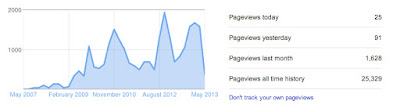
usage update: 25000 page-views and counting- the statistics.


The blog has now exceeded 25 000 page views (at the time of writing this 25 329) since it started.


Viewed in a variety of countries. 

The most popular postings in the last 30 days are mainly about student work with in The Department of Computing and Immersive Technologies, School of Science and Technologies, University of Northampton.

Popular Posts


Thank you to all those who have so far been contributors or who have posted comments.


The University of Northampton's, Department of Computing and Immersive Technologies offers five courses within the MSc Computing postgraduate provision (shown below) all available either part-time or full-time. 


BSc and HND Computing Provision (click on the links below for more details of the courses)


The contents are the opinion of the author and not necessarily the view of the University of Northampton.

Monday, 28 January 2013

Tool for web application vulnerability scanning

A recent MSc student project by Akhil Antony looked at a website that allows certain security risks (SQL Injection, Cross-Site Scripting (XSS), Cross-Site Request Forgery) to be tested for.


Abstract:
Web applications are open and available on the internet 24/7 and the attackers can easily access the applications from anywhere and can penetrate the system by identifying and exploiting the vulnerability exists within it. Probability of web applications to be attacked is very high compared to the offline applications. The number of new developments for security enhancements is tend to be increasing, on the other hand the new modern technologies like HTML5, CSS3, jQuery, Silverlight and so on creates new vulnerabilities every minute and the number of such attacks increasing in a very high order. The attacker not just looking for the sensitive information from the victims web application; these applications could be used for further criminal activities including terrorism, drug dealing etc. The research is to investigate the vulnerabilities affecting the web applications and to develop an automated web application vulnerability scanner. The investigation is also focuses on the motivations and profits behind these attacks. With this application users could be able to test the web application’s security rating based on the possible vulnerabilities and developers could be able to perform penetration search within their application.
Most of the web applications suffers from generic validation errors and causes security vulnerabilities. SQL Injection, Cross-Site Scripting (XSS), Cross-Site Request Forgery etc are examples of popular vulnerabilities exist within web applications. Majority of these web vulnerabilities are easy to identify and avoid, but unfortunately the developers are not much security aware or they work in very small time constraints. As a result more and more web applications on the internet would be vulnerable. (Stefan Kals, 2006)
The cyber crimes and the cyber attacks to web applications could be categorized on a general principle that what illegal offline is illegal online. The research is on the crimes which can only be carried out using the internet, including attacks on computer systems to disrupt IT infrastructure, and the stealing of data over a network using malware, often to enable further crime. The cyber attackers attempt to access information stored on a computer. Information may have a sale value (corporate espionage), may be valuable to the owner (ransom opportunity) or may be useful for further illegal activity such as fraud. Threats, motivations and profit achieved from cyber attacks being investigated.


Tuesday, 17 July 2012

Prabin Gautam: MSc to Published Author

Former MSc student Prabin Gautam has recently published his dissertation work as a book.


"Towards an Efficacious Adoption of IT in Developing Countries" was published July 2012 by LAP Lambert Academic Publishing.


Summary
The effective use and adoption of IT has the potential to deliver significant benefits to the developing countries. Despite of low level economic development, lack of infrastructure and long political instability, Nepal has been trying to prove its capability and aims to place itself in global IT map. Widened digital divide, brain drain, cost of IT infrastructure, power outage and insufficient connectivity infrastructures has always been felt as the challenges in IT adoption in the country. Beside that, increasing software piracy, lack of systematic framework for IT adoption leads to chaotic and uneven distribution of IT infrastructure in the country. This dissertation is based on the study and evaluation of IT scenario and adoption frameworks from various countries. It delivers the framework for efficacious IT adoption in countries like Nepal with the implementation of Open Technologies. Beside that, the thesis also suggests the roles and activities that must be carried out for making the investment in IT fruitful and how the building up of local expert pool and knowledgebase will help the country to be self reliable and reduces dependency on foreign proprietary software.


Tuesday, 20 March 2012

student internationally published

A paper has been accepted for publication at The 2012 China-Europe International Symposium on Software Engineering Education (CEISEE’2012), with an finalist student from 2011 as one of the co-authors.

To avoid potential bias for work on student experience during a problem-solving module; from tutors and to get honest feedback, the survey data collection and some of the analysis was carried out by an undergraduate computing student (one of the co-authors Kumuditha Achini Kariyawasam) under an URB@N funded project. URB@N stands for 'Undergraduate Research Bursaries at Northampton'. It is a bursary scheme that offers undergraduate students an opportunity to participate in a pedagogic research project taking place at the University of Northampton


Is it Visual? The importance of a Problem solving Module within a computing course
K A Kariyawasam

S J Turner

G J Hill

ABSTRACT
This paper looks at student’s view of the usefulness of a problem solving and programming module in the first year of a 3-year undergraduate program. The School of Science and Technology, University of Northampton, UK has been investigating, over the last seven years the teaching of problem solving. Including looking at whether a more visual approach has any benefits (the visual programming includes both 2-d and graphical user interfaces). Whilst the authors have discussed the subject problem solving and programming in the past this paper considers the students perspective from research collected/collated by a student researcher under a new initiative within the University.

All students interviewed either had completed the module within the two years of the survey or were completing the problem-solving module in their first year.


Thursday, 8 March 2012

Kinect, Autodesk and 3D stereo

John Marsh a third years student on BSc Computing (Computer Networks Engineering), University of Northampton has been working on using Microsoft's Kinect with 3D stereoscopic imagery. Producing a system where by hand gestures or head tracking 3D images can be rotated or zoomed in or out on. This work has been carried out with NVision and as well as commercial applications the potential for assistive technologies is being considered. The video below shows John using the system.

To learn more contact NVision


Computing Courses

BSc and HND Computing Provision (click on the links below for more details of the courses)


    The University of Northampton's, Department of Computing and Immersive Technologies offers five courses within the MSc Computing postgraduate provision (shown below) all available either part-time or full-time. 

    The contents are the opinion of the author(s) and not necessarily the view of the University of Northampton.