Showing posts with label STEM. Show all posts

Friday, 5 February 2016

Robot investment in Students

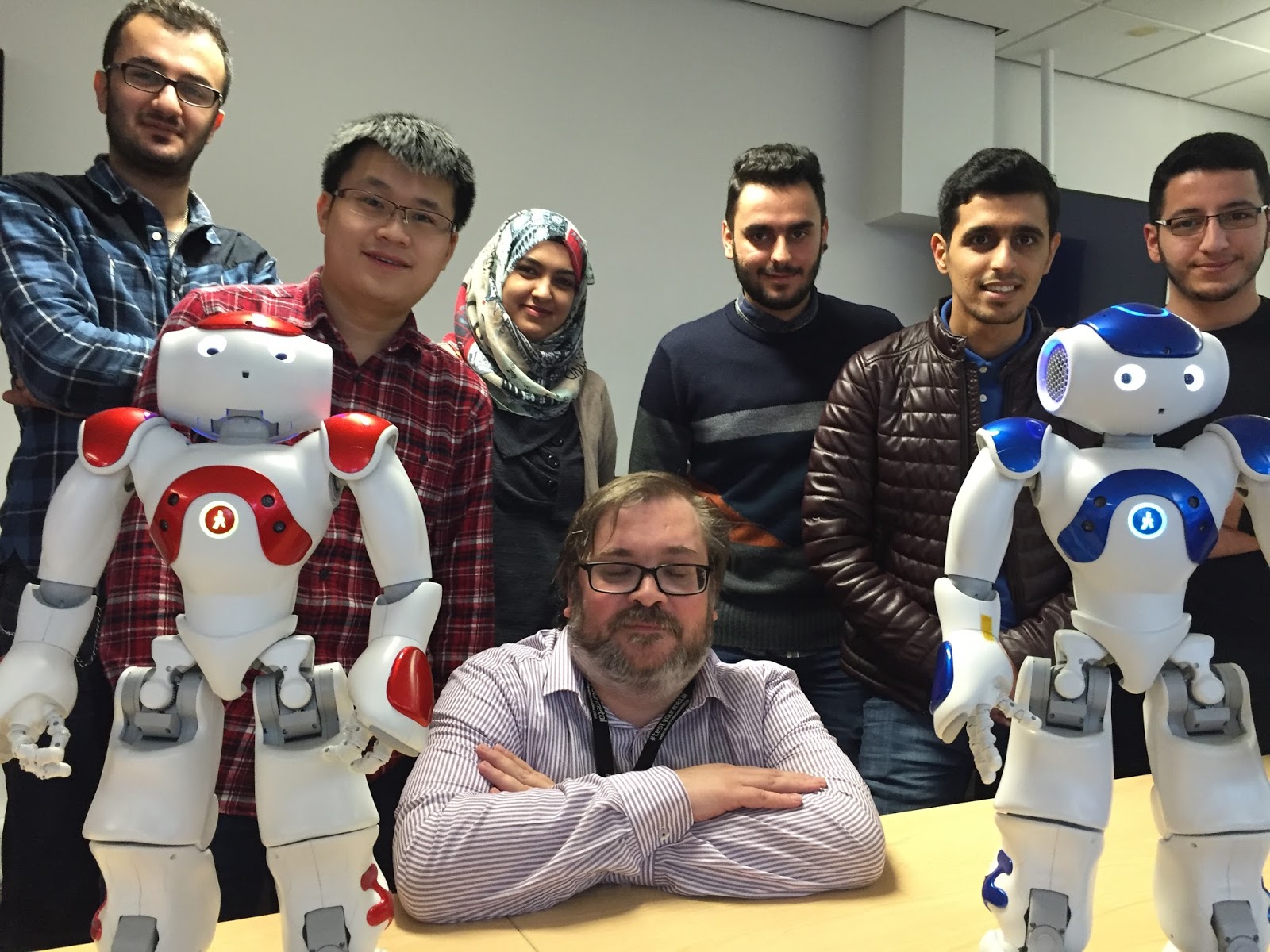
Just a short post about students and robots.  A recent investment in robots by the University of Northampton with matched from HEFCE has improved the capability of what can be taught. The larger robots, NAO robots from Aldebaran robotics, now enable the students to experience first-hand social robotics, which is predicted to be a growth area in robotics. The smaller robots are a few of the Picobot 2s, swarm robots from 4Tronix, adding  this capacity to the computing courses.

To read more about the overall investment click here.


All views and opinions are the author's and do not necessarily reflected those of any organisation they are associated with

Friday, 1 May 2015

Enhancing computing student employability skills through partnership working in STEM outreach.

A paper was recently presented at the 11th China-Europe International Symposium of Software Engineering Education, 29-30 April 2015, Zwickau, Germany http://whz-cms-10.zw.fh-zwickau.de/bo/index_CEISEE.html


Enhancing computing student employability skills through partnership working in STEM outreach.

Scott Turner, Associate Professor, Department of Computing and Immersive Technologies, University of Northampton, Northampton, NN2 6JB, UK


Abstract
Student volunteering is growing in the UK and elsewhere, and there is an ongoing debate about whether it is really “self-evidently a ‘good thing’” or there is a greater need for reflection to determine whether this statement is true (Holdsworth and Quinn, 2010).  This paper presents a personal reflection of Science, Technology, Engineering and Maths (STEM) volunteering as a potential route to increasing Computing student’s employability.
This paper looks at an approach at the University of Northampton that involves:
  • ·         Linking but not combining a local STEM volunteering scheme to the National STEM Volunteers (STEMNet 2015)
  • ·         Creation of a STEM Steering Group that has representation across all parts of the university.

Three brief case studies of computing student volunteers at different stages will be presented and culminate with a personal reflection based on observations over a ten year period.


References


  • Brewis, G., Russell, J., & Holdsworth, C. (2010). Bursting the bubble: Students, volunteering and the community. Research Summary.


  • Junkbots (2015) Junkbots [online] Available at: http://junkbots.blogspot.co.uk/ Accessed on: 24th January 2015.

  • Sinclair J, Allen A, Davis L, Goodchild T, Messenger J, Turner S (2014) "Enhancing student employability skills through partnership working in STEM outreach; the University of Northampton approach " HEA STEM Annual Teaching and Learning Conference 2013: Enhancing the STEM Student Journey, University of Edinburgh, 30th April-1st May 2014

  • STEMNet (2015) Science, Technology, Engineering and Mathematics Network [online] Available at: http://www.stemnet.org.uk/ Accessed on: 24th January 2015.


Scott is also on the International Programme committee (http://whz-cms-10.zw.fh-zwickau.de/bo/CEISEE_ProgComm.html)  and was a session chair for a paper session.


If you'd like to find out more about Computing at the University of Northampton go to: www.computing.northampton.ac.uk. All views and opinions are the author's and do not necessarily reflected those of any organisation they are associated with

Tuesday, 4 November 2014

What do Computing students do? STEM

Ben Foward, a second year student within the Department of Computing and Immersive  Technologies, University of Northampton, has been actively involved with STEM outreach activities. These include running activities but also being the student representative on the university-wide STEM Steering Group (http://mypad.northampton.ac.uk/stem/stem-steering-group/) . 

A example of an activity taken from http://mypad.northampton.ac.uk/stem/2014/10/29/be-steam-event-success/ is shown below:

BE STEAM Ideas wall
Students were able to find out how they can get involved in the University’s STEM Champion Programme, and the growing STEM network and the aims of the STEM Steering Group which represents staff and students from across Schools and professional services.
BE STEAM Biosciences How clean is your ....
Activities were led by STEM Champions including Ben Forward and Eunice Quason who demonstrated Greenscreening techniques (part of the Digital Leaders project), Ronan Egan and Julia Taylor who challenged fellow students to see how clean their hands and environment were, Izzie Trott cooked up some exciting experiments in her Kitchen Chemistry and Murhib Uddin got students thinking about introducing children to engineering through his Knex Challenge.
For more information go to: http://mypad.northampton.ac.uk/stem/


If you'd like to find out more about Computing at the University of Northampton go to: www.computing.northampton.ac.uk. All views and opinions are the author's and do not necessarily reflected those of any organisation they are associated with

Saturday, 7 December 2013

Junkbots! -session plans, activities

The School of Science and Technology at the University of Northampton have been working with local schools to create robots made from junk. This is an initiative by the University to introduce environmental sustainability, engineering and computing to students and has been funded by Northampton Enterprise Limited and east midlands development agency (emda). 

For more details:


This and other posters at Engage 2013 can be found at: https://www.publicengagement.ac.uk/engage2013/poster-party

Wednesday, 27 November 2013

Junkbots – it is not one thing!

The School of Science and Technology at the University of Northampton have been working with local schools to create robots made from junk. This is an initiative by the University to introduce environmental sustainability, engineering and computing to students and has been funded by Northampton Enterprise Limited and east midlands development agency (emda). 

For more details on the junkbots project go to: http://junkbots.blogspot.co.uk/ 

This and other posters at Engage 2013 can be found at: https://www.publicengagement.ac.uk/engage2013/poster-party

Saturday, 19 October 2013

Raspberry Pi in Northampton

A informal, but heavily over-subscribed (15 places but around 70 people registered interest), Raspberry Pi  event for  teachers and STEM ambassador was held at the University of Northampton on 16th October 2013. A collaboration between the Department of Computing and Immersive Technologies, University of Northampton; LEBC (who support STEM activities within Northamptonshire and Milton Keynes through the STEM ambassador); with support from BCS Northampton through the loan on the night of some extra equipment.

The session was meant to be (and I hope was) a chance to exchange ideas for teachers and ambassadors; set-up and try out Raspberry Pis; try a little Scratch or Python programming and to start up a discussion across the area what can be done (and is being done) with Raspberry Pi. Nigel Barrett (Corby Technical School) and Scott Turner (University of Northampton) facilitated the groups, with support from Julie Messenger and other LEBC staff.

Some interesting resources were highlighted


Thursday, 29 November 2012

Dad’s Robot Lab!


Taken from a blog written at Irchester Primary School http://lab13network.wordpress.com/2012/11/28/dads-robot-lab/ about a robot activity. For more details about Lab_13 go to: http://lab13network.wordpress.com/


Dad’s Robot Lab!

Hi! This is Morgan and Emily. Our Dads come to Dads Club in Lab_13.
Last week, we had some visitors! They demonstrated how all of the robots worked. There were some amazing remote controlled robots and a Lego robot. The name of the person who worked with all of the extraordinary robots was Scott Turner. We were amazed by the robots. Thank you for coming.
 The Lego robot could be controlled by the computer. The other robot could do handstands, roly-polys and cartwheels. Some were doing gymnastics, walking, bowing and dancing. The Lego robot just went all over the place!


Emily’s stepdad, Robin, said “It was fantastic – I want a robot for Christmas.”Unfortunately they are £800! And Kris, Kieran’s dad said “Thanks for organising the robot lab … a nice little event, an amazing robot!” 


Sunday, 2 September 2012

A diagrammatic language to build and share STEM teaching narratives


Dr Tina Wilson, Visiting Fellow with STRiPe (Science and Technology Research in Pedagogy) has recently had a paper published at the STEM Annual Conference 2012 at Imperial College and The Royal Geographical Society London 

Abstract

The general objective of this overall work is to propose a methodology for the creation of language-neutral multimedia materials (without audio or text), which can be directly embedded in STEM courses in any language. The overall design of this project was discussed in [1]

The design was based on four stages: 1) a very explicit design of the course, mainly on the dependence of the concepts, using Compendium, 2) the careful selection of icons for some key concepts, 3) the generation of short interrelated animations, which try to identify a suitable graphic language (with both formal syntax and semantics), 4) the proposal of metadata, some internal to each animation and other external, to interrelate them. The final export of this educational package would consist of animations and their metadata, which would help facilitate re-use, and embedding within other courses.


In this paper we focus on the third stage. In the types of short animations discussed, we detected two complementary vocabularies. The first one labels the intentionality of certain scenes: presentation of a formal definition, presentation of positive examples and negative examples. The 

second marks the dependence of the concepts and their construction process: for example, if one is a specialization of a previous one, or if you are graphically emphasizing the use of a universal or existential quantification at that point in the construction of the concept.

At this stage, as the ultimate goal, we hope to achieve a semi-automatic process of generating animations. From the definition of first order logic of a concept (or other less formal descriptions), through the graphic language that is being investigated. This is a goal to be achieved. But we trust 

that this contributes to the creation and reuse of materials in the STEM area beyond existing language barriers.


[1] J.L. Fernández-Vindel, and T. Wilson (2011). Multilingual media components directly embeddable 
in open educational resources in science and technology. International Conference on Education, 
Research and Innovation - ICERI 2011 14-16th November 2011, Madrid, Spain.


Paper can be found at: http://www.heacademy.ac.uk/assets/documents/stem-conference/Computing1/Jos%C3%A9-Luis_Fern%C3%A1ndez-Vindel_Tina_Wilson.pdf

Friday, 17 August 2012

Nuffield Bursary student 1 - Web sustainability

Ahsan Anderson has being working with Scott Turner from the University of Northampton on issues around Web Sustainability using a website designed to promote STEM (Science, Technology, Engineering and Mathematics) outreach activities as the vehicle. The work is being funded through a Nuffield Science Bursary. 

The project has been in three parts:

  • Investigating possible tools and approaches for web sustainability;
  • Developing a sustainable website to specification;
  • Looking an smartphones apps as a possible route for improving the use (and therefore sustainability) of the site. 
In this posting the outcomes from the first two parts are shown (the third will be a separate posting).


Investigating possible tools.

Details of this are available through these blog posts


STEM site

The site was developed and hosted using Weebly because of its easy of use, free tools and free hosting.

The site is sustainable because
- It has been design to be relatively simple to maintain
- Uses free tools
- Uses free web-hosting
- Relatively easy to transfer management
- Relatively easy to wrap most of the site and largely move it to another host.


Site: http://stemnorthamptonshire.weebly.com/home.html At the moment the outline of the site is is shown, with content to follow.

A user guide to maintaining the site has also been produced.


Thursday, 7 April 2011

Women in Computing: Mentoring


The six-month-long pilot project is being run at the University of Northampton. This a collaboration between Rashmi Dravid (School of Science and Technology) and Catherine Klimes (Head of Careers and Employability) sees female students undertaking Computing degrees at The University of Northampton being mentored by professional women already working in the sector. They will be taking part in seminars, conferences and workshops as part of the project, supported by some of the leading organisations in the computing sector and independent IT consultants

The project also aims to motivate, inspire and mentor younger girls by the university students  supporting career days and STEM (Science, Technology, Engineering and Mathematics) based events at the University and secondary schools