Showing posts with label programming. Show all posts

Monday, 9 May 2016

Northampton Computing OERs: over 2000 views


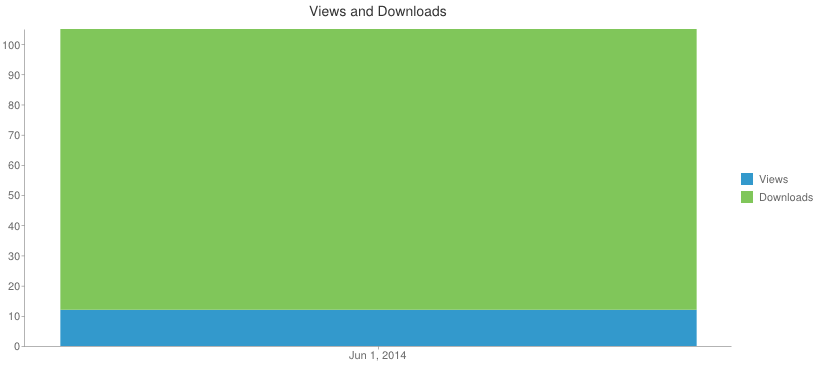
A selection of the open educational resources that have been released from the Department of Computing and Immersive Technologies, School of Science and Technology at the University of Northampton. The table below shows the views of the Jorum page and the items downloaded from the page. Some resources such as C programming have more individual items than say the summary of evolutionary algorithms.


viewsdownloads 
C Programming
948
5231
Summary of Evolutionary Algorithms
678
312
Problem-Solving
517
801


Total
2143
6344


Based on figures from Jorum at 16/5/2016.


Summary of Evolutionary Algorithms
Click here for the resource: http://find.jorum.ac.uk/resources/19204
These slides are intended for undergraduate computing students, providing an overview of Genetic Algorithms, a concept of in artificial intelligence. As well providing an overview the material also include links to applications via web resources. The slides are taken from an undergraduate artificial intelligence module on the BSc Computing Programme at the University of Northampton. Possible uses of these including support material for second year, third year or masters level course on artificial intelligence.

Click here for the resource: http://find.jorum.ac.uk/resources/19204


C Programming


Click here for the resource: http://find.jorum.ac.uk/resources/19192

In this material you will be introduced to some of the principles of programming, and specifically learn to write fairly simple programs using a programming language called C. An idea central to this material is that programming is about problem solving; you write a program to solve a particular problem. It is hoped that at the end of the material you should see that there is nothing magical or mysterious about programming. One of the features some people like about programming is you are making the computer do what you want. During the programming exercises, do not worry about making mistakes. In this material you will be expected to try out programs and eventually write your own. The target audience is anyone who wants to learn a programming language or is looking for some assessment questions around programming. The material was originally aimed at second year engineering students at the University of Northampton.
Click here for the resource: http://find.jorum.ac.uk/resources/19192


Problem-Solving


Author: Dr Scott Turner


These mini lectures are intended for undergraduate computing students, for providing simple steps in problem solving before the students learn a programming language. Problem-Solving and Programming is a common first year undergraduate module on the BSc Computing Programme at the University of Northampton. This material was taken from the problem solving part of the module and provides an introduction to five topics in problem-solving.

The resource can be found at: http://find.jorum.ac.uk/resources/19001


All  All views and opinions are the author's and do not necessarily reflected those of any organisation they are associated with

Friday, 26 February 2016

Student perceptions of different assessment modes in computer programming courses


Suraj Ajit
Assessment in HE Conference, Birmingham, UK, 23-24 June 2015


Abstract
Assessment is a process of measuring the extent to which students have fulfilled the expected learning outcomes for a course/module. There are many assessment strategies adopted by universities across the world for computer programming. They include written examination (closed book, open book), lab examination, multiple-choice/short-answer exams (paper or computer based), course work (or assignments) and oral examination. Again, the format, level and types of questions asked vary across universities. Assessment can take many forms, and it can be argued that the greater the diversity in the methods of assessment, the fairer, assessment is to students (Race 2007). The most effective form of assessment is one that appropriately examines the learning outcomes of the module. Assessment methods are also known to play an important role in how students learn (Brown 2004). The traditional assessment approach, in which one single written examination counts towards a student's total score, no longer meets new demands of programming language education (Wang, Li et al. 2012). Because computer programming is problem-solving oriented and very practical, the assessment of programming learning performance is challenging. The conventional assessment is not easy to be adapted to various new developments in computer programming education. This paper reports on the experience of adopting several assessment methods across programming modules for computing courses at the University of Northampton. In order to evaluate the assessment strategies from the students' perspective, a survey questionnaire was developed and distributed among a selected sample of final year computing course students. The paper discusses the results obtained from this survey. In particular, the paper compares the obtained results with that of other research performed in the same discipline as well as other disciplines. The key research questions the paper attempts to address are as follows:

1. What is the most effective assessment method for programming modules from a students' point of view?

2. How do student perceptions of computing (programming) assessments compare with that of other disciplines? Is programming any different?

3. How do the student performances relate to their perceptions of the assessment methods?


Citation:
Ajit, S.
 (2015) Student perceptions of different assessment modes in computer programming courses. Other presented to:Assessment in HE Conference, Birmingham, UK, 24-25 June 2015.


All views and opinions are the author's and do not necessarily reflected those of any organisation they are associated with

Thursday, 5 November 2015

Northampton Computing Research Impact 1 - Phiro Robot

A recently release kickstarter project website http://www.robotixedu.com/phiro.aspx has quoted research from the University of Northampton. This is an interesting product designed to teach children programming . In essence programming robots is good way to develop problem-solving skills.


The publication mentioned can be found at

  • Robots in problem-solving and programming (Scott J Turner, Gary Hill), In Proceedings of 8th Annual Conference of the Subject Centre for Information and Computer Sciences, Higher Education Academy Information and Computer Sciences Centre, Ulster, pp. 82--85, 2007. [paper]

  • With example related paper :

      • Problems first second and third (Gary Hill, Scott J Turner), In International Journal of Quality Assurance in Engineering and Technology Education (IJQAETE), volume 3, pp. 88--109, 2014. [paper]
      • Robotics within the teaching of problem-solving (Scott J Turner, Gary Hill), In ITALICS, volume 7, pp. 108--119, 2008.[paper]

    To read more about the research by the team in the area of robots for developing problem-solving skills go to:

    http://compuationalthinking.blogspot.co.uk/2015/03/problem-solving-publications.html


    If you'd like to find out more about Computing at the University of Northampton go to: www.computing.northampton.ac.uk. All views and opinions are the author's and do not necessarily reflected those of any organisation they are associated with or endorse the product.

    Friday, 2 October 2015

    The Race to the Top Code Competition takes off.

    The Race to the Top Coding Competition was launched today (2nd October 2015) at University of Northampton. 


    Northamptonshire County Council, The Worshipful Company of Information Technolgists (WCIT, a City of London Livery Company), Code Club and the University of Northampton have organised a competition for schools to encourage increased and improved teaching of computer coding.
    The aim of the competition is to inspire young people to achieve digital fluency through collaboration and challenge. The competition will run from the launch event on 2 October, 2015 until the closing date of 8 January, 2016.
    The entries will be judged by representatives from all four organisations and our sponsors, and the winning entries will be rewarded with The Northamptonshire Race to the Top Coding Competition Cup and prizes for the students and their schools.

    The Challenge

    • Primary Category, Years 4-6 – Groups of up to 6 students from Years 4, 5, or 6 will design a game based around saving energy using the coding programme Scratch. Students will also have to come up with their own team name and logo. They will then present their game to the judges with a 2 minute video uploaded to YouTube. This competition will be led by Code Club.
    • Secondary Category, Year 9 – Groups of up to 6 students will use coding to design a mobile application based around saving energy. Students will also have to come up with their own team name and logo. They will then present the app to the judges with a 2 minute video uploaded to YouTube. This competition will be led by WCIT and the University of Northampton.
    The games and apps will be judged by our panel, and the very best entries from each level will be awarded this year’s Race to the Top Coding Competition Cup and a personal Raspberry Pi computer. Level 2 winners will also be invited to represent the WCIT on their stand at the prestigious Livery Schools Link Showcase event at The City of London Corporation Guildhall in March, 2016


    A pod cast of the event by Alan O'Donohoe (alias Teknoteacher ) see below: 


    For more details on the competition go to Race to the Top Coding Competition


    If you'd like to find out more about Computing at the University of Northampton go to: www.computing.northampton.ac.uk. All views and opinions are the author's and do not necessarily reflected those of any organisation they are associated with

    Monday, 28 September 2015

    Race to the Top Coding Competition

    Race to the Top Coding Competition


    Northamptonshire County Council, The Worshipful Company of Information Technolgists (WCIT, a City of London Livery Company), Code Club and the University of Northampton have organised a competition for schools to encourage increased and improved teaching of computer coding.
    The aim of the competition is to inspire young people to achieve digital fluency through collaboration and challenge. The competition will run from the launch event on 2 October, 2015 until the closing date of 8 January, 2016.
    The entries will be judged by representatives from all four organisations and our sponsors, and the winning entries will be rewarded with The Northamptonshire Race to the Top Coding Competition Cup and prizes for the students and their schools.

    The Challenge

    • Primary Category, Years 4-6 – Groups of up to 6 students from Years 4, 5, or 6 will design a game based around saving energy using the coding programme Scratch. Students will also have to come up with their own team name and logo. They will then present their game to the judges with a 2 minute video uploaded to YouTube. This competition will be led by Code Club.
    • Secondary Category, Year 9 – Groups of up to 6 students will use coding to design a mobile application based around saving energy. Students will also have to come up with their own team name and logo. They will then present the app to the judges with a 2 minute video uploaded to YouTube. This competition will be led by WCIT and the University of Northampton.
    The games and apps will be judged by our panel, and the very best entries from each level will be awarded this year’s Race to the Top Coding Competition Cup and a personal Raspberry Pi computer. Level 2 winners will also be invited to represent the WCIT on their stand at the prestigious Livery Schools Link Showcase event at The City of London Corporation Guildhall in March, 2016.

    Website for more details:
    Race to the Top Coding Competition - Northamptonshire County Council


     If you'd like to find out more about Computing at the University of Northampton go to: www.computing.northampton.ac.uk. All views and opinions are the author's and do not necessarily reflected those of any organisation they are associated with

    Tuesday, 14 July 2015

    A Serious Games MSc - Computing, virtual reality


    MSc Computing (Serious Games) University of Northampton

    Serious Games are those that are designed with the main purpose not being pure entertainment, including but not exclusive to applications in defence, education and training, engineering, planning environment, medicine and behavioural change. This pathway is delivered to provide skills in necessary for serious games including, programming, modelling, internet programming and mobile devices. 

    Examples of the modules include:

    Media Techniques
    Computers now make use of a wide variety of digital media that is sound, images and graphics. The technology behind this media and the associated problems are very easy to overlook. This module describes the way in which each media is stored and manipulated within a computer system. The module guides the student through the techniques used which are all demonstrated by practical examples. The student is equipped with the techniques necessary to manipulate the media, using standard programming languages, in the same way as a commercial media package would do.

    Programming
    This module is designed to give the student an awareness of programming using a commercially available portable language. The student will gain programming skills, an awareness of developing client side programs and an appreciation of a computer language.  Also focus on skills needed in the analysis, design, implementation, testing and maintenance when developing a software programme. This will enable the student to make an effective contribution to a software development project. Experience will be gained to understand and implement graphic applications, consisting of two-dimensional graphics, three-dimensional graphics and animation.

    Modelling for Serious Games
    This module is designed to give the student an awareness of common modelling software and practices, as well as give an insight into the background and history of modelling. It will teach students to think around common problems presented over the course of a modelling project and help them develop visualisation solutions that are suitable in terms of functionality, performance and affordability for the given application. The module will also develop a wider understanding of industry applications and standards as well as imbuing the ideas and philosophies behind modelling for enterprise. Students will be exposed to cutting edge modelling technologies, including the NVision suite of immersive technologies
    Immersive Technologies
    This module gives students a deeper understanding of the principles and practicses of Virtual Reality technology. 


    All views and opinions are the author's and do not necessarily reflected those of any organisation they are associated with

    Friday, 1 May 2015

    Review of a problems-first approach to first year undergraduate programming

    A paper was recently presented at the 11th China-Europe International Symposium of Software Engineering Education, 29-30 April 2015, Zwickau, Germany http://whz-cms-10.zw.fh-zwickau.de/bo/index_CEISEE.html

    Review of a problems-first approach to first year undergraduate programming

    Gary J. Hill
    (Head of Department, Computing & Immersive Technologies, University of Northampton, Northampton, NN2 6JB, UK)


    ABSTRACT

    This paper, predominantly discusses the teaching of programming and problem solving to undergraduate first year computing students, using robots/robot simulators and visual programming to emulate the robot tasks. The needs to focus initial programming education on problem solving, prior to the teaching of programming syntax and software design methodology is also considered. The main vehicle for this approach is a robot/robot simulation programmed in Java, followed by the programming of a visual representation/simulation to develop programming skills. Problem solving is not trivial (Beaumont & Fox, 2003) and is an important skill, central to computing and engineering. The paper aims to summarise the authors earlier research on a problems-first approach to programming (Hill & Turner, 2011, 2014  to further emphasise the importance of problem solving, problem-based learning/project-based learning and the benefits of both physical and visual solutions.

    The importance of linking the problem-solving robot activity and the programming assignment, whilst maintaining the visual nature of the problem, will be discussed, together with the comparison of this work with similar work reported by other authors relating to teaching programming using robots (Williams, 2003, Burbaitė et al., 2013).


    The approaches discussed have been disseminated to colleagues, not only within the author’s University, but also in Europe and internationally (Kariyawasam, Turner & Hill, 2012, Hill & Turner, 2011, 2014) . Development funding support has also been received from the Higher Education Academy (HEA) – Information & Computer Sciences (ICS) Development Fund (2015a) and the HEA-ICS/Microsoft Innovative Teaching Fund (2015b).


    References
    Adams, J., Turner, S., Kaczmarczyk, S., Picton, P., & Demian, P. (2008). Problem solving and creativity for undergraduate engineers: Findings of an action research project involving robots. Paper presented at the International Conference on Engineering Education (ICEE 2008), Budapest, Hungary.
     
    Adams J. P., & Turner, S. J., (2008) Problem Solving and Creativity for Undergraduate Engineers: process or product? International Conference on Innovation, Good Practice and Research in Engineering Education July 14-16, 2008, Loughborough, England, Higher Education Academy. 9781904804659.
     
    Burbaitė, R., Damaševičius, R., Štuikys, V., (2013) Teaching of Computer Science Topics Using Meta-Programming-Based GLOs and LEGO Robots, Informatics in Education - An International Journal (Vol12_1), pp125-142.
     
    Beaumont, C., & Fox, C. (2003). Learning programming: Enhancing quality through problem-based learning. In proceeding of 4th Annual Conference of the subject centre for Information and Computer Sciences of the Higher Education Academy (pp. 90-95). Newtownabbey, Northern Ireland: Higher Education Academy.
     
    Bloom, B. S. (Ed.). (1956). Taxonomy of educational objectives, handbook I: Cognitive domain. White Plains, NY: Longman.
     
    Chickering, A. W., Gamson. Z., F. (1987) "Seven Principles for Good Practice in Undergraduate Education." AAHE Bulletin 39:3-7. ED 282 491.6 pp. MF-01; PC-01.
     
    Computing Curricula. (2001) IEEE CS, ACM Joint Task Force on Computing Curricula, IEEE Computer Society Press and ACM Press. Retrieved January 22, 2015 from http://www.acm.org/education/curricula.html.
     
    Gallopoulos E, Houstis E, Rice JR (1994) Computer as Thinker/Doer: Problem-Solving Environments for Computational Science IEEE Computational Science and Engineering pp 11-23
    http://dx.doi.org/10.1109/99.326669
     
    Gold. N., (2010) Motivating Students in Software Engineering Group Projects: An Experience Report. Innovation in Teaching and Learning in Information and Computer Sciences 9(1), 10-19. DOI: 10.11120/ital.2010.09010010
    http://dx.doi.org/10.11120/ital.2010.09010010
     
    Greenfoot (2013) Teach and Learn Java Programming. Retrieved August 1, 2013, from http://www.greenfoot.org/
     
    HEA-ICS Development Fund (2015a) HEA-ICS Development Fund [online] Available from: http://www.ics.heacademy.ac.uk/projects/development-fund/index.php [Accessed February 2015].
     
    HEA-ICS/Microsoft Innovative Teaching Fund (2015b) "Developing problem-solving teaching materials based upon Microsoft Robotics Studio" [online] Available from: http://www.ics.heacademy.ac.uk/projects/development-fund/fund_details.php?id=88 [Accessed February 2015].
     
    Hill, G. and Turner, S. J. (2014) Problems first, second and third. International Journal of Quality Assurance in Engineering and Technology Education (IJQAETE). 3(3), pp. 88-109. 2155-496X.
     
    Hill G. J., Turner S. (2011) "Chapter 7: Problems First", Software Industry-Oriented Education Practices and Curriculum Development: Experiences and Lessons, M Hussey, X Xu & B Wu (Eds.), IGI Global, USA, pp 110-126, ISBN: 978-1-60960-797-5.
     
    Houghton, W., (2004) How can Learning and Teaching Theory assist Engineering Academics? [online]. School of Engineering - University of Exeter. Available from: http://www.engsc.ac.uk/er/theory/problemsolving.asp [Accessed November 2007].
     
    JICC5 (2001) Java & the Internet in the Computing Curriculum, Higher Education Academy (HEA) – Information and Computer Sciences (ICS) Conference, South Bank University, London, 22nd Jan, (http://www.ics.heacademy.ac.uk/events/displayevent.php?id=127).
     
    Kariyawasam K., A., Turner S., Hill G. (2012) "Is it Visual? The importance of a Problem Solving Module within a Computing course", Computer Education, Volume 10, Issue 166, May 2012, pp. 5-7, ISSN: 1672-5913.
     
    Microsoft. (2006). Microsoft robotics studio. Retrieved February 14, 2008, from http://msdn2.microsoft.com/en-us/robotics/aa731520.aspx
     
    Savin-Baden, M. & Wilkie, K. (2004) (eds) Challenging Research in Problem-based Learning. Maidenhead: Open University Press/SRHE.
     
    Turner S., Hill G. J., (2010) Innovative Use of Robots and Graphical Programming in Software Education, Computer Education, Volume 9, May 2010, pp. 54-6, ISSN: 1672-5913.
     
    Turner S., Hill G. J., (2008) Robots within the teaching of Problem-Solving, ITALICS, HEA-ICS, Volume 7 Issue 1, June 2008, pp. 108-119, ISSN: 1473-7507. http://dx.doi.org/10.11120/ital.2008.07010108
     
    Turner S., Hill G. J., (2007) Robots in Problem-Solving and Programming 8th Annual Conference of the Subject Centre for Information and Computer Sciences, University of Southampton, 28th - 30th August 2007, pp 82-85 ISBN 0-978-0-9552005-7-1
     
    Turner S., Hill G. J., (2006) The Inclusion of Robots Within The Teaching OF Problem Solving: Preliminary Results, 7th Annual Conference of the ICS HE Academy, Trinity College, Dublin, 29th - 31st August 2006, Proceedings pg 241-242 ISBN 0-9552005-3-9
     
    Wing, J. (2006). Computational thinking. Communications of the Association for Computing Machinery, 49(3), 33.
    http://dx.doi.org/10.1145/1118178.1118215


    Gary is also on the International Programme committee (http://whz-cms-10.zw.fh-zwickau.de/bo/CEISEE_ProgComm.html)  and was a panel member of the discussion of Software Engineering Education and Industry


    If you'd like to find out more about Computing at the University of Northampton go to: www.computing.northampton.ac.uk. All views and opinions are the author's and do not necessarily reflected those of any organisation they are associated with

    Tuesday, 12 August 2014

    C Programming online teaching material

    Another new Open Education Resource (OER) has been made available by the Department of Computing and Immersive Technologies, School of Science and Technology, University of Northampton.


    C Programming


    Click here for the resource: http://find.jorum.ac.uk/resources/19192
    Author: 
    Created: 11 August 2014, by School of Science and Technology, University of Northampton
    In this material you will be introduced to some of the principles of programming, and specifically learn to write fairly simple programs using a programming language called C. An idea central to this material is that programming is about problem solving; you write a program to solve a particular problem. It is hoped that at the end of the material you should see that there is nothing magical or mysterious about programming. One of the features some people like about programming is you are making the computer do what you want. During the programming exercises, do not worry about making mistakes. In this material you will be expected to try out programs and eventually write your own. The target audience is anyone who wants to learn a programming language or is looking for some assessment questions around programming. The material was originally aimed at second year engineering students at the University of Northampton.
    Published: 11 August 2014, by 
    Keywords: C Programming; Programming; Problem solving; Computer science; Computing 

    Click here for the resource: http://find.jorum.ac.uk/resources/19192


    views are the authors, and may not reflect the views of any organisation the author is connected with in any way.

    Tuesday, 22 July 2014

    Physical Computing: Junkbots with a brain!

    Figure 1
    A new stage for the Junkbots project (http://junkbots.blogspot.co.uk/ ) starts this week. Up to this point the junk bot building has largely being about building a moving (or drawing) 'bot' moved by vibration - limited control, but fun.

    This week, A Nuffield funded bursary student starts working on investigating whether LEGO NXT or Raspberry Pi based solutions can be incorporated with the bot to add some control of the movement (still by vibration).


    Idea One 

    Is to add a LEGO NXT brick, plus motors that are made to vibrate, to a junkbot similar to one shown in figure 1. The motor and broken propeller combination being replaced with the NXT brick and LEGO motor. A good potential feature is it a self-contained unit with power and control together, as well as being potentially fairly simple to set-up.


    Idea Two

    Is to do a similar approach as idea one but keep the motor and broken propeller combination but control the motors via a Raspberry Pi.


    For both approaches there are questions to be considered including 

    • Will the additions be too heavy? 
    • If it is too heavy could it be done with a single controlled motor?
    • What is the best programming choice?
      • For idea one is it the language that comes with the NXT or other programming language?
      • For idea two Scratch or Python?
    • How much control is there?
    • For idea two is this too complex to be taken into schools.

    It is hoped that in the end, there will be some resource for others to use, that involves relatively simple 'robot' programming of a junk-based robot.

    Deatils of the work will be published on the Junkbots Blog (http://junkbots.blogspot.co.uk/ ) as the project progresses.

    Wednesday, 11 June 2014

    Open Educational Resources: Problem-Solving

    A new Open Education Resource (OER) has been made available by the Department of Computing and Immersive Technologies, School of Science and Technology, University of Northampton.


    Problem-Solving

    Author: Dr Scott Turner


    Details

    These mini lectures are intended for undergraduate computing students, for providing simple steps in problem solving before the students learn a programming language. Problem-Solving and Programming is a common first year undergraduate module on the BSc Computing Programme at the University of Northampton. This material was taken from the problem solving part of the module and provides an introduction to five topics in problem-solving.


    The resource can be found at: http://find.jorum.ac.uk/resources/19001


    Saturday, 7 December 2013

    Junkbots! -session plans, activities

    The School of Science and Technology at the University of Northampton have been working with local schools to create robots made from junk. This is an initiative by the University to introduce environmental sustainability, engineering and computing to students and has been funded by Northampton Enterprise Limited and east midlands development agency (emda). 

    For more details:


    This and other posters at Engage 2013 can be found at: https://www.publicengagement.ac.uk/engage2013/poster-party

    Wednesday, 27 November 2013

    Junkbots – it is not one thing!

    The School of Science and Technology at the University of Northampton have been working with local schools to create robots made from junk. This is an initiative by the University to introduce environmental sustainability, engineering and computing to students and has been funded by Northampton Enterprise Limited and east midlands development agency (emda). 

    For more details on the junkbots project go to: http://junkbots.blogspot.co.uk/ 

    This and other posters at Engage 2013 can be found at: https://www.publicengagement.ac.uk/engage2013/poster-party

    Thursday, 21 November 2013

    Analyse the Risks of Ad Hoc Programming in Web Development and Develop a Metrics of Appropriate Tools

    A paper has recent being published by Dr Ali Al-Sherbaz, Department of Computing and Immersive Technologies, University of Northampton 

    Analyse the Risks of Ad Hoc Programming in Web Development and Develop a Metrics of Appropriate Tools

    Manish Gubhaju,, Ali Al-Sherbaz

    Abstract

    Today the World Wide Web has become one of the most powerful tools for business promotion and social networking. As the use of websites and web applications to promote the businesses has increased drastically over the past few years, the complexity of managing them and protecting them from security threats has become a complicated task for the organizations. On the other hand, most of the web projects are at risk and less secure due to lack of quality programming. Although there are plenty of frameworks available for free in the market to improve the quality of programming, most of the programmers use ad hoc programming rather than using frameworks which could save their time and repeated work. The research identifies the different frameworks in PHP and .NET programming, and evaluates their benefits and drawbacks in the web application development. The research aims to help web development companies to minimize the risks involved in developing large web projects and develop a metrics of appropriate frameworks to be used for the specific projects. The study examined the way web applications were developed in different software companies and the advantages of using frameworks while developing them. The findings of the results show that it was not only the experience of developers that motivated them to use frameworks. The major conclusions and recommendations drawn from this research were that the main reasons behind web developers avoiding frameworks are that they are difficult to learn and implement. Also, the motivations factors for programmers towards using frameworks were self-efficiency, habit of learning new things and awareness about the benefits of frameworks. The research recommended companies to use appropriate frameworks to protect their projects against security threats like SQL injection and RSS injection.

    Friday, 2 August 2013

    video tools and machinima for animations

    I was challenged to find come up to produce a video welcome message for a module, the problem is I dislike appearing in a video - I tend to use an avatar in place of a picture of myself.


    Here are two example video introductions using two different tools.

    Example 1: Photostory 3
    A free piece of software (http://www.microsoft.com/en-gb/download/details.aspx?id=11132) that takes photos and allows you to add narration, music and some effects. Moviemaker software will do in it's place.

     The module was a MSc Computing dissertation module giving a short overview of the module.


    Example 2 and 3: Machinima
    A second approach was to use a package that allows you to guide/direct a character, scripting what they say, etc. The package used was an early version of Moviestorm (newer educational version can be found here) it allows you to 'direct' the character and save me having to appear in it! 


    This module is an introduction to artificial intelligence module.
     

    The second one is an introduction to a problem solving and programming module.

    Placed inside a VLE:


    Ok, they were done as a couple of experiments and a bit a fun; but are worth a play with.


    Computing Courses

    BSc and HND Computing Provision (click on the links below for more details of the courses)


    The University of Northampton's, Department of Computing and Immersive Technologies offers five courses within the MSc Computing postgraduate provision (shown below) all available either part-time or full-time. 

    The contents are the opinion of the author(s) and not necessarily the view of the University of Northampton.

    The machinima software can also be found at: