Showing posts with label robots. Show all posts

Saturday, 30 May 2020

junkbots: School Outreach 1

3 MINUTE READ

Junkbots session 1: Move the robot

from Junkbots: Move the robot
by Scott Turner

What is the Junkbots project

The Junkbots project has been running for a number of years as an initiative to bring sustainability, computing and engineering together by building bots out of junk; details of the project can be found at. https://junkbots.blogspot.com/ . Junkbots is an extension of the Research into the teaching problem-solving going on at the University of Northampton please feel to visit https://computingnorthampton.blogspot.com/2019/01/problem-solving-research-outputs-and.html for more details. These activities were tried to in a primary school.

What are we going to do?

Play with a Scratch robot on the screen! Guess what the routine does. Run the routine see if it does as we guessed. Consider what it did and if it is different to what we thought it was going to do. Change the routine a little bit to do another task.


Activity 1: What blocks are we using?

This means when the green flag is pressed do whatever follows.


This means place our robot (go to block) to point on the screen roughly in the centre of the screen.


Do you want a challenge: What do think would happen if instead 0 and 0 in the white spaces in the go to block, we put in 50 and 50? Have a guess.


This means stop the scratch program for 1 second and the carry on.


We can use this block to move the robot 50 steps on the screen in the direction it is facing.

Do you want a challenge: How do you think we could get the robot to move 100 steps? Have a guess.


We can use this block to turn the robot to the right 45 degrees.

Do you want a challenge: How do you think we could get the robot to move 90 degrees to the right? Have a guess.

We are also going to look at two more ‘things’ today: one new block and a new type of blocks to make our programming easier – the control blocks.


We can use this block to change the direction the robot faces.


When we click on the control button at the side we see several more blocks we can use.

One of these we have played with before the wait block.

The other two we are going to use today in later activities.

When we want to repeat a combination of blocks so many times, we can use the middle block and then change the 10 to the number of times we want to repeat.

If we want it repeat something forever (or until we stop the program with the red button) we can use the last block.


Activity 2: Have a go at guessing what it is going to do?

Using what you have learnt in Activity 1.

Let us look at this block of programming.


What do you think it is going to do? If you have someone helping you tell them what you think it does.

If you don’t get it exactly right, it is more important to have a guess.

Activity 3: Try it for yourself

Now go to the weblink: https://scratch.mit.edu/projects/3 84342734 You should see something that looks like figure below 


Click on the box at the top of the screen that says see inside. You should a screen similar to figure above Now press the green flag it should now perform a little dance.

Questions

Does the robot work the way you thought it would from Activity 2? If it did move the way you thought– great! If it didn’t move the way thought still good. What was different?

Activity 4: Change it a bit

Save your work from Activity 3 by going to the top of the screen: find file, click on it and the click on Save to your computer. Then press the save button. Now change the code so that the robot moves in a square. Hint: We need to move in a straight line and then turn 90 degrees several times.

Did the robot work the way you thought it would? If it did move the way you thought– great! Can you make it move in a rectangle where two sides are longer than the other two? If it didn’t move the way thought still good. What was different?

Activity 5: Try it for yourself

Save your work from Activity 4. Now produce a dance routine for the robot. It must include moving forward and at least three turns.

You could also try adding in 

 Making it move backwards (negative number in the move block) 

 Turning left 


Activity 6: Have a go at guessing what it is going to do?

Follow this link to a new Scratch project https://bit.ly/ScratchJunkbot2

Challenge 1: Can you describe using the chat what you see it do?

Challenge 2: Can you rewrite the routine so when you press the green flag it hits the rock? What happens when it hits the rock share on the chat? Can you do this using less than seven blocks?

Challenge 3: Rewrite the routine so when we press the green flag it goes around the rock in a square. Hints: You did a similar task last week so please feel free use what you have done before. You might have to change the starting position of the robot. It is worth putting the wait blocks in to help you see it in action.

Activity 7: Modify and Make

Now go to the weblink: https://bit.ly/Junkbot3 Press the green flag and see what it does. Challenge 4: Using the chat describing what it did, please include when do you think it will stop? Challenge 5: How can we change this so that it goes around the rock twice?

Activity 8: Modify and make play

Challenge 6: Try and change what you did in Activity 3 so that the robot goes around the block in a different shape Challenge 7: The really tough challenge. How to we get the robot to move in a figure 8? It must not hit the rock. Have a go yourself and if you want to see one possible answer (there are more than one way to do this) go to https://scratch.mit.edu/projects/398164007/

Questions

Does the robot work the way you thought it would? If it did move the way you thought– great! Can you make it move in a rectangle where two sides are longer than the other two? If it didn’t move the way thought still good. What was different?If you would like to know more about the Junkbots project contact scott.turner@northampton.ac.uk


 If you would like to know more about the Junkbots project contact scott.turner@northampton.ac.uk


All views and opinions are the author's and do not necessarily reflected those of any organisation they are associated with. Twitter: @scottturneruon

Friday, 4 March 2016

Exploring robotics with Red and Smurf

In an in-reach STEAM activity day I have had the opportunity to show off two NAO robots in action to a group of 8-years olds. As well presenting a short presentation on social robots (see below). By the way Red and Smurf are the nicknames for the two robots.


If you'd like to find out more about Computing at the University of Northampton go to: www.computing.northampton.ac.uk. All views and opinions are the author's and do not necessarily reflected those of any organisation they are associated with

Thursday, 5 November 2015

Northampton Computing Research Impact 1 - Phiro Robot

A recently release kickstarter project website http://www.robotixedu.com/phiro.aspx has quoted research from the University of Northampton. This is an interesting product designed to teach children programming . In essence programming robots is good way to develop problem-solving skills.


The publication mentioned can be found at

  • Robots in problem-solving and programming (Scott J Turner, Gary Hill), In Proceedings of 8th Annual Conference of the Subject Centre for Information and Computer Sciences, Higher Education Academy Information and Computer Sciences Centre, Ulster, pp. 82--85, 2007. [paper]

  • With example related paper :

      • Problems first second and third (Gary Hill, Scott J Turner), In International Journal of Quality Assurance in Engineering and Technology Education (IJQAETE), volume 3, pp. 88--109, 2014. [paper]
      • Robotics within the teaching of problem-solving (Scott J Turner, Gary Hill), In ITALICS, volume 7, pp. 108--119, 2008.[paper]

    To read more about the research by the team in the area of robots for developing problem-solving skills go to:

    http://compuationalthinking.blogspot.co.uk/2015/03/problem-solving-publications.html


    If you'd like to find out more about Computing at the University of Northampton go to: www.computing.northampton.ac.uk. All views and opinions are the author's and do not necessarily reflected those of any organisation they are associated with or endorse the product.

    Thursday, 13 August 2015

    Safaa defends his PhD

    Congratulations to Safaa H Shwail who recently successfully defended his PhD at the University of Babylon around optimal methods for path-planning with multi-robots. The work was rated 'excellent' and was supervised in Iraq by Dr Alia Karim.


    Part the research was carried out at the University of Northampton with Dr Scott Turner (University of Northampton) for six months in 2013. During this time the work focussed on looking at two path-finding techniques within a multi-robot simulation. Details of this part of the work can be found below. 

    Probabilistic Multi Robot Path Planning in Dynamic Environments: A Comparison between A* and DFS

    Safaa H Shwail, Alia Karim and Scott Turner.
    International Journal of Computer Applications


    Abstract


    In this paper, a probabilistic roadmap planner algorithm with the multi robot path planning problem have been proposed by using the A* search algorithm in a dynamic environment. The whole process consists of two phases. In the first phase: Preprocessing phase, the work space is converted into the configuration space, constructing a probabilistic roadmap graph in the free space, and finding the optimal path for each robot using a global planner that avoids the collision with thestatic obstacles. The second phase: Moving phase, moves each robot in a prioritized manner from its starting point to its ending point through a near optimal path with avoiding collision with the moving obstacles and the other robots. A comparison has been done with the depth first algorithm to see the difference. The simulation results shows that choosing A* search algorithm affect positively the speed of the two phases together in comparison to the depth first search algorithm. 


    Citation
    Safaa H Shwail, Alia Karim and Scott Turner. Article: Probabilistic Multi Robot Path Planning in Dynamic Environments: A Comparison between A* and DFS. International Journal of Computer Applications 82(7):29-34, November 2013. Published by Foundation of Computer Science, New York, USA
    DOI: 
    10.5120/14130-2251


    If you'd like to find out more about Computing at the University of Northampton go to: www.computing.northampton.ac.uk. All views and opinions are the author's and do not necessarily reflected those of any organisation they are associated with

    Tuesday, 11 August 2015

    opinion:Will machines replace people in the workplace?

    This is an opinion piece first published on Medium.

    Will machines replace people in the workplace? — Medium: "Will machines replace people in the workplace?

    Dr ​​Scott Turner​, Associate Professor in Computing and Immersive Technologies, gives his view on machines replacing people at work…"


    To read more go to: https://medium.com/@UniNorthants/will-machines-replace-people-in-the-workplace-82cdac229e68


    'via Blog this'

    Monday, 26 January 2015

    Creative Computational Thinking blog


    A new blog has been launched by Scott Turner  looking at Computational Thinking (http://compuationalthinking.blogspot.co.uk/ - the typo in the name is there on purpose). As a blog there is not a particular target audience apart from those interested in Computational Thinking or problem-solving.

    At the time of writing so far there have been posts on robots, apps, and overview of Computational Thinking.


    If you'd like to find out more about Computing at the University of Northampton go to: www.computing.northampton.ac.uk. All views and opinions are the author's and do not necessarily reflected those of any organisation they are associated with.

    Friday, 15 August 2014

    Controlling junk with LEGO

    In a recent post (http://computingnorthampton.blogspot.co.uk/2014/07/physical-computing-junkbots-with-brain.html)  adding Mindstorm NXT brick and motors to a drinks can to produce a junkbot was consider as an idea. As a new stage for the Junkbots project (http://junkbots.blogspot.co.uk/ ) some preliminary work has been done into this.

    Up to this point the junk bot building has largely being about building a moving (or drawing) 'bot' moved by vibration - limited control, but fun. A Nuffield funded bursary student, Hayden Tetley,  has being working within staff from the University of Northampton on whether LEGO NXT or Raspberry Pi based solutions can be incorporated with the bot to add some control of the movement (still by vibration).


    Idea One 

    Is to add a LEGO NXT brick, to move a junkbot similar.The motor and broken propeller combination in the earlier junkbots is replaced with the NXT brick and LEGO motor. A good potential feature is it a self-contained unit with power and control together, as well as being potentially fairly simple to set-up. This is the focus of this post. 

    Here are some videos showing idea one in action using LEGO motors, brick and the software that comes with the LEGO Mindstorms NXT (LEGO):


    For more information on how this was done go to: http://legojunkbots.weebly.com/uploads/3/7/2/2/37227791/nuffield_nxt_mindstorms.docx or http://legojunkbots.weebly.com/

    Idea Two

    Is to do a similar approach as idea one but keep the motor and broken propeller combination but control the motors via a Raspberry Pi. This will be discussed in another post.

    Details of the work will be published on the Junkbots Blog (htttp://junkbots.blogspot.co.uk/ ) as the project progresses.


    Saturday, 21 December 2013

    Robots in Hartwell

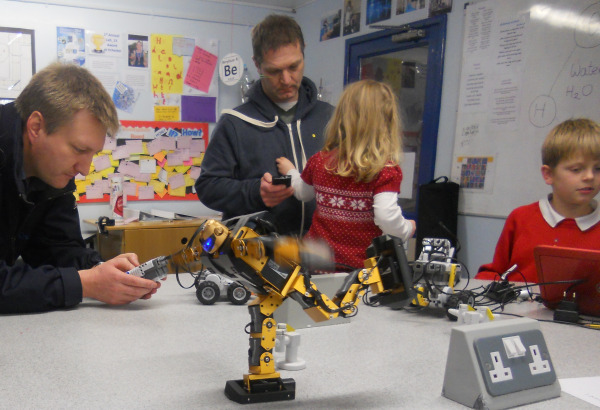
    On 19th December 2013 the  junkbot project visited  Class 4 of Hartwell C of E Primary School, Northamptonshire, UK.

    The session was split into two.


    Robonova in action
    The one part  involved using robots to create a routine based around either Robonova robots (an image to the left taken from an earlier event) and a Sphero were  were brought in. 

    • Two groups use the Robvova (robots to create a dance routine. Infrared controllers were used to select the movements. 'Memory' came from the children writing down the key presses used in the dance routine to be repeated later during a 'dance off'. 
    • The third group used the Sphero (http://www.gosphero.com/) robot; both programming them (using an App Sphero Macrolab on the iPad) and directly controlled it using another App (OrbBasic)on the iPad. 


    So all three groups did some of the basic principles of programming/problem-solving by deciding what they wanted to do and create a routine to do it.


    The other part was building a drawing junkbot  from cans, small electric motors, broken propellers, wires, pencils, pens, and drinks cans. An example from a previous group is shown to the left.


    More details on the activities/session plans can be found at:


    Saturday, 7 December 2013

    Junkbots! -session plans, activities

    The School of Science and Technology at the University of Northampton have been working with local schools to create robots made from junk. This is an initiative by the University to introduce environmental sustainability, engineering and computing to students and has been funded by Northampton Enterprise Limited and east midlands development agency (emda). 

    For more details:


    This and other posters at Engage 2013 can be found at: https://www.publicengagement.ac.uk/engage2013/poster-party

    Wednesday, 27 November 2013

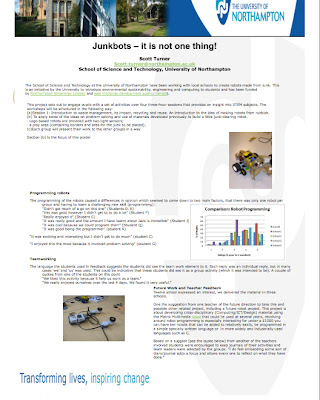
    Junkbots – it is not one thing!

    The School of Science and Technology at the University of Northampton have been working with local schools to create robots made from junk. This is an initiative by the University to introduce environmental sustainability, engineering and computing to students and has been funded by Northampton Enterprise Limited and east midlands development agency (emda). 

    For more details on the junkbots project go to: http://junkbots.blogspot.co.uk/ 

    This and other posters at Engage 2013 can be found at: https://www.publicengagement.ac.uk/engage2013/poster-party

    Friday, 15 November 2013

    Robots link Northampton, Babylon and Baghdad

    A paper has recently being published on a collaboration between University of Northampton; University of Babylon; and University of Technology, Baghdad on path-finding using multiple robots in a dynamic environment.


    Probabilistic Multi Robot Path Planning in Dynamic Environments: A Comparison between A* and DFS

    Safaa H Shwail, Alia Karim and Scott Turner.
    International Journal of Computer Applications


    Abstract


    In this paper, a probabilistic roadmap planner algorithm with the multi robot path planning problem have been proposed by using the A* search algorithm in a dynamic environment. The whole process consists of two phases. In the first phase: Preprocessing phase, the work space is converted into the configuration space, constructing a probabilistic roadmap graph in the free space, and finding the optimal path for each robot using a global planner that avoids the collision with thestatic obstacles. The second phase: Moving phase, moves each robot in a prioritized manner from its starting point to its ending point through a near optimal path with avoiding collision with the moving obstacles and the other robots. A comparison has been done with the depth first algorithm to see the difference. The simulation results shows that choosing A* search algorithm affect positively the speed of the two phases together in comparison to the depth first search algorithm. 


    Citation
    Safaa H Shwail, Alia Karim and Scott Turner. Article: Probabilistic Multi Robot Path Planning in Dynamic Environments: A Comparison between A* and DFS. International Journal of Computer Applications 82(7):29-34, November 2013. Published by Foundation of Computer Science, New York, USA
    DOI: 
    10.5120/14130-2251

    Wednesday, 6 November 2013

    Robot visit at Buckingham School

    Taken from: Coderdojo at The Buckingham School - Northampton University – Visits Buckingham School:

    The room awaited as the man with the robots arrived.  A hushed silence, whilst eager minds listened to what Scott Turner Associate professor as Northampton University outlined the plan for the evenings activities/workshop.  Teams of students were given motors, helicopter blades/wheels/ pens and tape and challenged to problem solve.  The other half of the group split into two halves to look at the two robots – RoboNova-1 and Sphero experimenting with mini challenges, bit of robot football and speed challenge.  Thanks must go to Scott and Team for visiting.

    To go to the original follow: http://buckinghamschoolcoderdojo.edublogs.org/northampton-university-visits-buckingham-school/

    'via Blog this'

    Saturday, 10 August 2013

    Computing at School: Junkbots project


    Details of the Junkbots project lead from the Department of Computing and Immersive Technologies, University of Northampton and outline teaching material can now be found at Computing At School website or CAS Online | Junkbots project

    Computing at School is an organisation that aims to promote the teaching of Computing at school and is a partnership of the BCS, industrial partners. For more details go to: http://www.computingatschool.org.uk/index.php?id=about-us

    For more details on the project contact - Scott Turner

    Thursday, 3 January 2013

    Read all about it - AI and robotics sites


    What is curation software?
    The number of resources on the internet is increasing in most areas and search engines can are helpful but it is not the same as someone telling you this is a good resource. Digital curation takes this further allowing people to produce lists of internet resources that can be dynamically updated but filtered resources - if you like a dynamic reading list of web resources.


    1. Scoopit(http://www.scoop.it)


    Two examples sites curated in Northamptonshire:

    artificial intelligence for students


    Robot resource


    The good feature of scoop.its is you have control over what content you present, you are the filter. Content suggestions are also made, but it is up to you if you select them. 

    If you have suggestions for what could be added to either site please add a comment to this posting.


    Thursday, 29 November 2012

    Dad’s Robot Lab!


    Taken from a blog written at Irchester Primary School http://lab13network.wordpress.com/2012/11/28/dads-robot-lab/ about a robot activity. For more details about Lab_13 go to: http://lab13network.wordpress.com/


    Dad’s Robot Lab!

    Hi! This is Morgan and Emily. Our Dads come to Dads Club in Lab_13.
    Last week, we had some visitors! They demonstrated how all of the robots worked. There were some amazing remote controlled robots and a Lego robot. The name of the person who worked with all of the extraordinary robots was Scott Turner. We were amazed by the robots. Thank you for coming.
     The Lego robot could be controlled by the computer. The other robot could do handstands, roly-polys and cartwheels. Some were doing gymnastics, walking, bowing and dancing. The Lego robot just went all over the place!


    Emily’s stepdad, Robin, said “It was fantastic – I want a robot for Christmas.”Unfortunately they are £800! And Kris, Kieran’s dad said “Thanks for organising the robot lab … a nice little event, an amazing robot!” 


    Monday, 31 October 2011

    Robot workshop

    Work within the School of Science and Technology, University of Northampton was presented at a recent workshop,  Robotics Workshop: Bot Shop! 28th October 2011 at the University of Derby.


    The work presented discussed using Lego Robots to support the learning of Neural Networks on an artificial intelligence module.The aim being to use the advantages of using robots, their visual and physical nature, as a way of making the slightly abstract nature of the neurons and multi-layer perceptrons more concrete by examples.


    For more details on the Workshop go to: http://www.ics.heacademy.ac.uk/events/displayevent.php?id=260


    Tuesday, 21 June 2011

    Lego Mindstorms – Sentry Robots

    Sameer Kumar Shrestha

    The report presents the dissertation on title Prototype of Sentry Robots for Advanced Security which includes the use of LEGO robots showing interaction between each other with the help of wireless communication medium in Bluetooth. The purpose of the work is to build a communication between multiple LEGO robots using the wireless technology. For this task, the NXT version of LEGO Mindstorms has been selected. It is because there is need of complex communication which is possible through wireless medium such as Bluetooth and also a suitable processing device for the proposed task which is present in the LEGO Mindstorms NXT. The report has also focused on the background information about the NXT system and its great flexibility with LeJOS NXJ as the programming platform. The outcome is the implementation of developed work with the use LEGO Mindstorms NXT and the LeJOS NXJ as programming platform. The task was approached with one LEGO NXT robot maintaining the distance between the object in the environment and searching the object by rotating in case of lost. After the completion of the first task, the next task was to study the communication behavior of multiple robots communicating with each other to fulfill the same job. For this, three NXT robots were taken and programmed in such a way that they form the shape of triangle and keep tracking the object.  All three of them send and wait for the information from each other and process this information to produce a suitable output, i.e. to respond to the action from each other. Thus, it was found that the implementation of several processes to multiple LEGO based communication had faults, due to the technical hitches with the communication technology and limitations of the NXT systems.


    BSc and HND Computing Provision (click on the links below for more details of the courses)
    The University of Northampton's, Department of Computing and Immersive Technologies offers five courses within the MSc Computing postgraduate provision (shown below) all available either part-time or full-time.