Showing posts with label phd. Show all posts

Tuesday, 25 October 2016

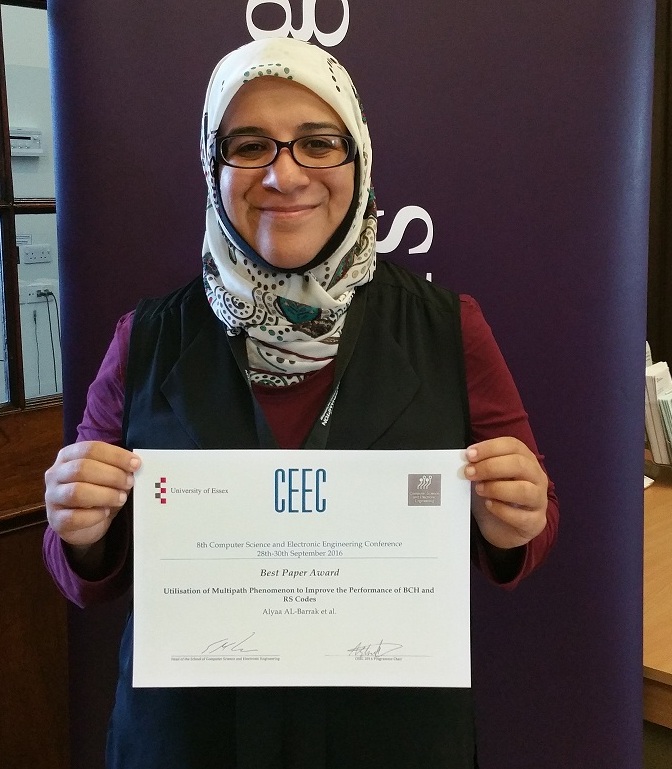
PhD student awarded best paper for her revolutionary research in wireless communication

Taken from: http://www.northampton.ac.uk/news/phd-student-awarded-best-paper-for-her-revolutionary-research-in-wireless-communication/


alyaareresearchpaper2
Not only was PhD student Alyaa Al-Barrak awarded the best paper at a recent conference, she has also had an offer for her paper to be published in a digital library, which hosts documents  from some of the world’s most highly cited publications in the engineering and computer science field.
The eighth Computer Science and Electronic Engineering Conference was held at the University of Essex and is a great opportunity for researchers to meet and network with peers in the same field. Alyaa presented her research paper on wireless communication and the errors that can occur due to noise, reflection, diffraction, shadowing, fading and in particular the multipath phenomenon and the most widely used technique to correct it. Her paper was awarded first place out of 93 other papers, which has led to an inclusion in the Institute of Electrical and Electronics Engineers’ Xplore Digital Library and an offer to publish an extended paper in a journal.
Alyaa said: “I was so pleased to be awarded the best paper at the conference and consider this a great achievement which has encouraged me to go further in this field. It has also provided me with evidence that I am delivering high-quality research and it will be a great addition to my CV.”
Robin Crockett, Alyaa’s Director of Studies, said: “Alyaa’s supervisors, Ali Al-Sherbaz, Triantafyllos Kanakis and myself are immensely proud of Alyaa. This is a major achievement and major recognition of Alyaa’s work from other researchers in the field of digital communications.”
Triantafyllos Kanakis, Lecturer in Computing, commented: “The solution proposed in this paper is revolutionary, drastically increasing the overall performance of a wireless system while saving expensive channel resources from retransmission.”
Ali Al-Shabaz, Senior Lecturer in Computing, commented: “The research outcomes of this work will have an impact on future technology and smart applications. The next stage of Alyaa’s research is expected to find more interesting results which will be worthy of publication in a journal with a high impact factor.”


All views and opinions are the author's and do not necessarily reflected those of any organisation they are associated with. Twitter: @scottturneruon

Friday, 19 February 2016

Ahmad Al-Khalil successfully defended his PhD


Well done to Ahmad Al-Khalil who successfully defended his PhD thesis titled “Vehicle to vehicle communication: Channel modelling and coding” today.  

His supervisory team:
Scott Turner, 
Yinghui Zhang 
Ali Al-Sherbaz.

Related Blogs:


If you'd like to find out more about Computing at the University of Northampton go to: www.computing.northampton.ac.uk. All views and opinions are the author's and do not necessarily reflected those of any organisation they are associated with

Friday, 14 June 2013

Fully funded PhD Studentship in collaboration with GE Aviation Systems Ltd

Fully funded PhD Studentship in collaboration with GE Aviation Systems Ltd

The University of Northampton

£13726 per annum (including £1000 research expenses budget) and tuition fees for 3 years
Applications are invited for a 3-year fully-funded PhD studentship in the area of Model-Based Software Engineering. This PhD project will be funded jointly by both The University of Northampton and GE Aviation Systems Ltd.
Project Description
Model-Based Development (MBD) is seeing widespread adoption in a variety of domains within industry, especially in aviation. Industries around the world are reporting significant benefits from its use. However, the extent to which MBD can be used effectively in the software development lifecycle is unclear.
GE Aviation Systems primarily uses natural language (textual ‘shall’ statements) to express software requirements. These textual statements are often ambiguous, untestable, incorrect, missing detail, etc. Finding this out late in the development lifecycle proves very expensive. To this end, GE Aviation Systems has turned to MBD. They still use textual statements to express software requirements, but they supplement the requirements writing activity with modelling and simulation so that engineers gain a better understanding of the requirements and their faults. The models can then be refined and improved and serve as the Software Design artefacts that are used to auto-generate code. Currently, this means they have to write tests manually to test the design against the requirements. The study will investigate whether they could use models to express requirements and use those models to auto-generate test cases for testing the design model. This would then increase their productivity. To summarise, the research project will study the feasibility of model based tool support to capture requirements and automate requirements based testing.
Eligibility Criteria
  • The studentship is open to both national and international candidates.
  • Candidates should have at least an upper second class honours degree (UK or equivalent) and/or a strong Masters degree in computer science or related discipline.
  • Candidates should have good programming skills in Java and/or C++ and an appreciation of the Software Development Lifecycle.
Deadline for Applications: 28th July 2013
Start date: To be negotiated
Informal enquiries can be made to Dr. Suraj Ajit (suraj.ajit@northampton.ac.uk)

The application form should be completed and submitted by email to: researchdegrees@northampton.ac.uk. Include a comprehensive CV.
Attachments should be in PDF or Word format.
Please quote reference: UN13MBD

Friday, 22 February 2013

Northampton - Babylon strategic partnership potential

Strategic partnership with the University of BabylonTaken from: The University of Northampton lays down the foundations of a strategic partnership with the University of Babylon  http://www.northampton.ac.uk/news/article/446/the-university-of-northampton-lays-down-the-foundations-of-a-strategic-partnership-with-the-university-of-babylon
The University of Northampton’s School of Science and Technology was pleased to welcome visitors from the University of Babylon in Iraq.
Led by Professor Dhirgham Alkhafaji, Director of Scientific Affairs & Cultural Relations, the visit, which took place on 19 February, is the culmination of several months of discussions between colleagues in the School of Science and Technology and their counterparts in Babylon.
During the visit, discussions took place, and agreements were reached on several initiatives, including a package for PhD supervision, 2+2 (two years at Babylon, two years at Northampton) in Computing, staff exchange, consultancy and knowledge transfer in the area of solid wastes management.
Professor Kamal Bechkoum, Executive Dean of the School of Science and Technology, commented: “This is a significant partnership that fits in with the School’s internationalisation plan and we are delighted about progress thus far.”
More news stories can be found at: http://www.northampton.ac.uk/news

Computing Courses

BSc and HND Computing Provision (click on the links below for more details of the courses)
The University of Northampton's, Department of Computing and Immersive Technologies offers five courses within the MSc Computing postgraduate provision (shown below) all available either part-time or full-time. 


Tuesday, 22 March 2011

PREDICTING LEATHER HANDLE LIKE AN EXPERT BY ARTIFICIAL NEURAL NETWORKS

A paper has been recently published that combines artificial intelligence and leather science research looking at modelling the subjective assessment of leather handle.

Abstract

This study developed an artificial neural network model to predict the subjective assessment of leather handle by an expert using its measurable physical characteristics. A statistical method was applied to prune the inputs of the network and the “error band” conception was proposed during training.


More details can be found at:

Wang, Y., Picton, P., Turner, S. and Attenburrow, G (2011) Predicting Leather Handle like an Expert Artificial Neural Networks, Applied Artificial Intelligence, Volume 25, Issue 2  February 2011 , pages 180 - 192 ISSN: 0883-9514 DOI:10.1080/08839514.2011.545218