Al Barrak, A., Al-Sherbaz, A., Kanakis, T. and Crockett, R. G. M. (2017) Utilisation of multipath phenomenon to improve the performance of BCH and RS codes. In: 8th Computer Science & Electronic Engineering Conference. New York: IEEE. 978-1-5090-2050-8. pp. 6-11
DOI: 10.1109/CEEC.2016.7835880
Abstract
In wireless communication, there exists a phenomenon known as ‘multipath’. This phenomenon is considered as a disadvantage because it causes interference. The multipath phenomenon results in an antenna receiving two or more signals from the same sent signal from different paths. This paper considers them as redundant copies of the transmitted data and utilises them to improve the performance of forward error correction (FEC) codes without extra redundancy, in order to improve data transmission reliability and increase the bit rate over wireless communication channels. The system was evaluated in bit error rate (BER) and used Bose, Ray-Chaudhuri and Hocquenghem (BCH) and Reed-Solomon (RS) codes as FEC. The results showed that the utilisation of the multipath improves the performance of FEC. Furthermore, the performance of FEC codes had t1 error correction capability and employed the multipath is better than FEC codes have t2 error correction capability and without the multipath, where t1 < t2. Consequently, the bit rate is increased, and communication reliability is improved without extra redundancy.
To read more: http://ieeexplore.ieee.org/document/7835880/
All views and opinions are the author's and do not necessarily reflected those of any organisation they are associated with. Twitter: @scottturneruon
Showing posts with label wireless. Show all posts
Showing posts with label wireless. Show all posts
Friday, 10 February 2017

Wednesday, 8 February 2017
efficient channel model evaluating NoC architectures DOI: 10.1109/SBAC-PADW.2016.23
Opoku Agyeman, M., Vien, Q.-T., Hill, G., Turner, S. J. and Mak, T. (2017) An efficient channel model for evaluating Wireless NoC architectures. In: 2016 International Symposium on Computer Architecture and High Performance Computing Workshops (SBAC-PADW). Online: IEEE. 978-1-5090-4844-1. pp. 85-90.
DOI: 10.1109/SBAC-PADW.2016.23
All views and opinions are the author's and do not necessarily reflected those of any organisation they are associated with. Twitter: @scottturneruon
Abstact
Wireless Networks-on-Chip (WiNoCs) have emerged to solve the scalability and performance bottleneck of conventional wired NoC architectures. However unlike communication in the macro-world, on-chip communication poses several constraints, hence there is the need for simulation and design tools that consider the effect of the wireless channel at the nanotechnology level. In this paper, we present a parameterizable channel model for WiNoCs which takes into account practical issues and constraints of the propagation medium, such as transmission frequency, operating temperature, ambient pressure and distance between the on-chip antennas. The proposed channel model demonstrates that total path loss of the wireless channel in WiNoCs suffers from not only dielectric propagation loss (DPL) but also molecular absorption attenuation (MAA) which reduces the reliability of the system.
To read the full-text go to either An efficient channel model for evaluating Wireless NoC architectures or http://ieeexplore.ieee.org/document/7803701/
All views and opinions are the author's and do not necessarily reflected those of any organisation they are associated with. Twitter: @scottturneruon
Tuesday, 25 October 2016
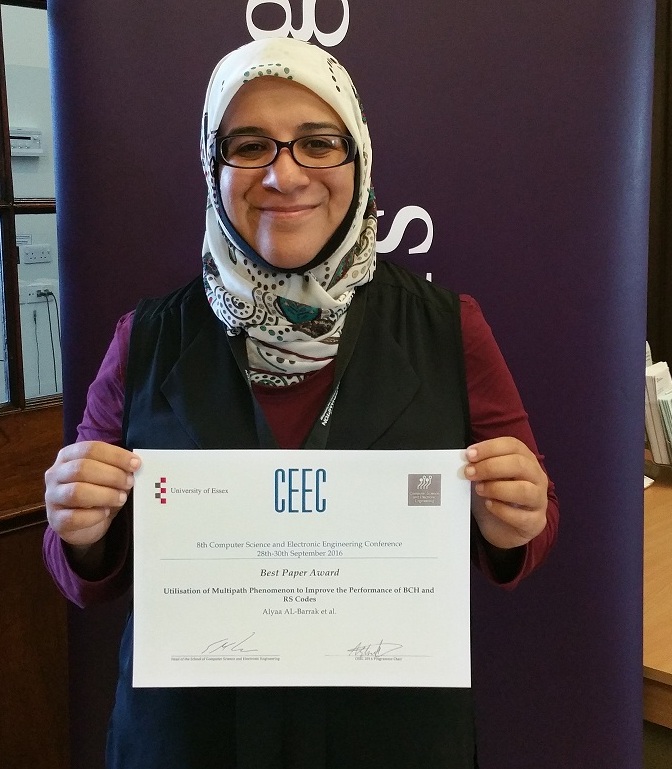
PhD student awarded best paper for her revolutionary research in wireless communication
Taken from: http://www.northampton.ac.uk/news/phd-student-awarded-best-paper-for-her-revolutionary-research-in-wireless-communication/
All views and opinions are the author's and do not necessarily reflected those of any organisation they are associated with. Twitter: @scottturneruon
Not only was PhD student Alyaa Al-Barrak awarded the best paper at a recent conference, she has also had an offer for her paper to be published in a digital library, which hosts documents from some of the world’s most highly cited publications in the engineering and computer science field.
The eighth Computer Science and Electronic Engineering Conference was held at the University of Essex and is a great opportunity for researchers to meet and network with peers in the same field. Alyaa presented her research paper on wireless communication and the errors that can occur due to noise, reflection, diffraction, shadowing, fading and in particular the multipath phenomenon and the most widely used technique to correct it. Her paper was awarded first place out of 93 other papers, which has led to an inclusion in the Institute of Electrical and Electronics Engineers’ Xplore Digital Library and an offer to publish an extended paper in a journal.
Alyaa said: “I was so pleased to be awarded the best paper at the conference and consider this a great achievement which has encouraged me to go further in this field. It has also provided me with evidence that I am delivering high-quality research and it will be a great addition to my CV.”
Robin Crockett, Alyaa’s Director of Studies, said: “Alyaa’s supervisors, Ali Al-Sherbaz, Triantafyllos Kanakis and myself are immensely proud of Alyaa. This is a major achievement and major recognition of Alyaa’s work from other researchers in the field of digital communications.”
Triantafyllos Kanakis, Lecturer in Computing, commented: “The solution proposed in this paper is revolutionary, drastically increasing the overall performance of a wireless system while saving expensive channel resources from retransmission.”
Ali Al-Shabaz, Senior Lecturer in Computing, commented: “The research outcomes of this work will have an impact on future technology and smart applications. The next stage of Alyaa’s research is expected to find more interesting results which will be worthy of publication in a journal with a high impact factor.”
All views and opinions are the author's and do not necessarily reflected those of any organisation they are associated with. Twitter: @scottturneruon
Wednesday, 19 October 2016
An efficient channel model for evaluating Wireless NoC architectures

Opoku Agyeman, M., Vien, Q.-T., Hill, G., Turner, S. J. and Mak, T.
Workshop on Applications for Multi-Core Architectures.
7th Workshop on Applications for Multi-Core Architectures (WAMCA)
Abstract
Wireless Networks-on-Chip (WiNoCs) have emerged to solve the scalability and performance bottleneck of conventional wired NoC architectures. However unlike communication in the macro-world, on-chip communication poses several constraints, hence there is the need for simulation and design tools that consider the effect of the wireless channel at the nanotechnology level. In this paper, we present a parameterizable channel model for WiNoCs which takes into account practical issues and constraints of the propagation medium, such as transmission frequency, operating temperature, ambient pressure and distance between the on-chip antennas. The proposed channel model demonstrates that total path loss of the wireless channel in WiNoCs suffers from not only dielectric propagation loss (DPL) but also molecular absorption attenuation (MAA) which reduces the reliability of the system
All views and opinions are the author's and do not necessarily reflected those of any organisation they are associated with. Twitter: @scottturneruon
Wednesday, 17 February 2016
Network coding/forward error correction code for multiple-input multiple-output wireless communication system
Network coding/forward error correction code for multiple-input multiple-output wireless communication system
Al Barrak, A., Al-Sherbaz, A., Kanakis, T. and Crockett, R. G. M.
8th Manchester Metropolitan University (MMU) Postgraduate Research Conference 2015: Innovation, Manchester Metropolitan University, 05 November 2015.
Abstract
A reliable wireless communication channel is amongst the most important issues in a wireless network. Due to its nature, a reliable wireless communication channel is a challenge to provide. Wireless channel diversity is an efficient technique to achieve reliable transmission. Multi-antenna exploits spatial diversity as a method that has been proved to drastically increase channel capacity while keeping bit error rates (BER) near Shannon (lower bound) limits.
Forward error correction code (FEC) or channel coding is an error control technique that is used to provide a time diversity to immunize data against errors over the noisy and unreliable wireless channel (Duman & Ghrayeb, 2007). The main idea behind FEC is that the transmitter encodes data by using error correction code (ECC) to add redundancy. This redundancy allows the receiver to detect and correct a specific number of bits in error - at a time - that may occur in the data stream.
Multiple-input multiple-output (MIMO) systems combined with channel coding are shown to improve system BER and channel capacity performance in wireless communications. The combination is often referred to as a coded MIMO system.
The aim of this research is to design or improve a FEC code algorithm for wireless communication network. This algorithm should be suitable to combine with MIMO system and be able to detect and correct the corrupted data in order to decrease the BER and increase wireless channel efficiency. The computational complexity and the data overhead will be used to measure the performance efficiency of the proposed algorithm.
Forward error correction code (FEC) or channel coding is an error control technique that is used to provide a time diversity to immunize data against errors over the noisy and unreliable wireless channel (Duman & Ghrayeb, 2007). The main idea behind FEC is that the transmitter encodes data by using error correction code (ECC) to add redundancy. This redundancy allows the receiver to detect and correct a specific number of bits in error - at a time - that may occur in the data stream.
Multiple-input multiple-output (MIMO) systems combined with channel coding are shown to improve system BER and channel capacity performance in wireless communications. The combination is often referred to as a coded MIMO system.
The aim of this research is to design or improve a FEC code algorithm for wireless communication network. This algorithm should be suitable to combine with MIMO system and be able to detect and correct the corrupted data in order to decrease the BER and increase wireless channel efficiency. The computational complexity and the data overhead will be used to measure the performance efficiency of the proposed algorithm.
Al Barrak, A., Al-Sherbaz, A., Kanakis, T. and Crockett, R. G. M. (2015) Network coding/forward error correction code for multiple-input multiple-output wireless communication system. Workshop presented to: 8th Manchester Metropolitan University (MMU) Postgraduate Research Conference 2015: Innovation, Manchester Metropolitan University, 05 November 2015.
If you'd like to find out more about Computing at the University of Northampton go to: www.computing.northampton.ac.uk. All views and opinions are the author's and do not necessarily reflected those of any organisation they are associated with
Sunday, 15 February 2015
Chaos based cryptography for voice encryption in wireless communication

Chaos based cryptography for voice encryption in wireless
communication
Sadkhan, S., Al-Sherbaz,
A. and Mohammed, R.
International Conference on Electrical, Communication,
Computer, Power, and Control Engineering (ICECCPCE).
Iraq: IEEE.
pp. 191-197
Abstract
The vast growths in mobile and wireless
applications would contain lacks of using suitable security concepts during the
development process which worries the information security research community.
This paper reviews most of the encryption techniques which adopt chaos based
cryptography, and illustrates the used of chaos based voice encryption
techniques in wireless communication as well. The review in this paper
summarized the traditional and modern techniques of voice/speech encryption and
demonstrated the feasibility of adopting chaos based cryptography for in
wireless communications.
citation: Sadkhan, S., Al-Sherbaz, A. and Mohammed, R. (2015) Chaos based cryptography for
voice encryption in wireless communication. In: International Conference on
Electrical, Communication, Computer, Power, and Control Engineering (ICECCPCE). Iraq:
IEEE. pp. 191-197
If you'd like to find out more about Computing at the University of Northampton go to: www.computing.northampton.ac.uk. All views and opinions are the author's and do not necessarily reflected those of any organisation they are associated with
Tuesday, 2 September 2014
Patent for wireless mesh network
Dr Ali Al-sherbaz is awarded patent tilted (Method and Process for Routing and Node addressing in Wireless Mesh Networks). The patent concerns a mathematical idea to solve a technical problem in wireless mesh network. On 27th August 2014, the patent application was granted.
More details of the patent can be found in these links:
For more details contact
Dr. Ali Al-Sherbaz
PhD,MSc, BSc, FHEA, MIEEE, MBCS
School of Science & Technology,
The University of Northampton, St Georges Avenue,
The University of Northampton, St Georges Avenue,
Northampton, NN2 6JD, United Kingdom
t: +44 (0)1604 893182
w: www.alisherbaz.co.uk
t: +44 (0)1604 893182
w: www.alisherbaz.co.uk
Tuesday, 8 July 2014
Network Coding/Cryptography for Wireless Network Security over Galois Field Theory
 Alyaa Al Barrak, a PhD student at the University of Northampton, is working on linking wireless networking using Galois Field Theory. An overview of the work is shown below.
Abstract
Network Security (NS) is a concept
to protect data
transmission over network. Security is a
method to making sure that unauthorized people cannot influence the data. Coding
is a method to ensuring that data remain readable even in the existence of
errors. Network coding points out to each node taking its received packets,
computing a linear combination over a finite field, and forwarding the result
to another node till reach the final destination.
Data integrity is a major concept in
any coding system. For example, if a packet is traveled over a network which is
prone to noise, interference and channel fading then it could be altered by a
network coding method and determining the optimum coding coefficients is a
challenge.
Complexity and the overhead are two
significant keys in the NC which are used to measure the efficiency of the
coding algorithms in terms of errors correction rate and computational power.
The aim of this research is to evaluate
and design an algorithm for wireless communication networking using Galois
Field Theory taking into account data integrity. This algorithm will be able to
detect the damaged data and decrease the bit errors rate.


Supervisory team
Dr Ali Al-Sherbaz
Prof. Kamal Bechkoum
Dr Robin Crockett.
Tuesday, 19 March 2013
Dr Ali Al-Sherbaz: Mobile, wireless and networking
Research interests
Recent Publications
- Computer Network and Wireless Technologies
- Mobile Ad-Hoc Routing
- Signal Processing and Cognitive Radio
- Cybernet Security
- Computational Mathematics
Recent Publications
2013
- ihsan lami, Ali Al-Sherbaz (2013) W2BC: A Proposal for a Converged Baseband Implementation of WiMax and WiFi Transceivers International Journal of Information and Network Security (IJINS) Vol.2, No.1, February 2013, pp. 426 - 437 ISSN: 2089-3299
2012
- Dravid R and Al-Sherbaz, A (2012) Optimization of Routing Protocols for Wireless Mesh Networks (WMNs) to Achieve Higher Quality of Service for Real-Time Applications 3rd Annual Grace Hopper Celebration of Women in Computing, Bangalore, India, December 12-14 2012
- Turner, S. and Al-Sherbaz, A. (2012) What's the problem with problem-solving? Seminar Presentation presented to: Insights into the future of learning and teaching at Northampton, University of Northampton, 3rd December 2012
- Al-Sherbaz A, Dravid R (2012) "Ultilising Mobile Mesh Networks for Disaster Management" M4D2012, 27-29 February 2012, New Delhi, India
- Al-Sherbaz A, Minai A, Xue J, Dravid R (2011) "An Embedded Pedagogic Model for Computer Forensics within an
Undergraduate Programme" 7th Annual Teaching Computer Forensics Workshop, University of Sunderland 10th November 2011
2010
- AL-SHERBAZ, A.; KUSELER, T.; ADAMS, C.; MARŠÁLEK, R.; POVALAČ, K. (2010) WiMAX Parameters Adaptation Through A Baseband Processor Using Discrete Particle Swarm Method. International Journal of Microwave and Wireless Technologies, Cambridge Press, 2010, vol. 2010 (2), no. 2, p. 1 - 7. ISSN: 1759- 0787.
2009
- Al-Sherbaz A., C. Adams, S. Jassim (2009) “WiMAX-WiFi Convergence with OFDM Bridge”, SPIE Defence and Security Proceeding Conference, Orlando, Florida USA, April-2009.
2008
- Al-Sherbaz A., C. Adams, S. Jassim (2008) “Convergence in wireless transmission technology promises best of both worlds”, SPIE Opt electronics and Optical Communications newsroom, Nov-2008
- Al-Sherbaz A., C. Adams, S. Jassim (2008) “Private Synchronization Technique for Heterogeneous Wireless Network (WiFi and WiMAX)”, SPIE Defence and Security Proceeding Conference, Orlando, Florida USA, March-2008
- Li F., A. Al-Sharbaz, S. Jassim, and C. Adams (2008), “Credibility Based Secure Route Finding in Wireless Ad Hoc Networks”, SPIE Defence and Security Proceeding Conference, Orlando, Florida USA, March-2008
Contact: ali-al-sherbaz@northampton.ac.uk
Subscribe to:
Posts (Atom)