Showing posts with label multipath. Show all posts

Wednesday, 14 June 2017

PhD student Alyaa Al Barrak's latest paper

Al Barrak, A.Al-Sherbaz, A.Kanakis, T. and Crockett, R. G. M. (2017) Enhancing BER performance limit of BCH and RS codes using multipath diversity. Computers. 6 2073-431X.


Abstract:
Modern wireless communication systems suffer from phase shifting and, more importantly, from interference caused by multipath propagation. Multipath propagation results in an antenna receiving two or more copies of the signal sequence sent from the same source but that has been delivered via different paths. Multipath components are treated as redundant copies of the original data sequence and are used to improve the performance of forward error correction (FEC) codes without extra redundancy, in order to improve data transmission reliability and increase the bit rate over the wireless communication channel. For a proof of concept Bose, Ray-Chaudhuri, and Hocquenghem (BCH) and Reed-Solomon (RS) codes have been used as FEC to compare their bit error rate (BER) performances. The results showed that the wireless multipath components significantly improve the performance of FEC. Furthermore, FEC codes with low error correction capability and employing the multipath phenomenon are enhanced to perform better than FEC codes which have a bit higher error correction capability and did not utilise the multipath. Consequently, the bit rate is increased, and communication reliability is improved without extra redundancy.


All views and opinions are the author's and do not necessarily reflected those of any organisation they are associated with. Twitter: @scottturneruon

Saturday, 18 February 2017

And so it begins


2017 has started off well for the Computing team at University of Northampton with four papers coming out in January and February 2017.


Abstract
In wireless communication, there exists a phenomenon known as ‘multipath’. This phenomenon is considered as a disadvantage because it causes interference. The multipath phenomenon results in an antenna receiving two or more signals from the same sent signal from different paths. This paper considers them as redundant copies of the transmitted data and utilises them to improve the performance of forward error correction (FEC) codes without extra redundancy, in order to improve data transmission reliability and increase the bit rate over wireless communication channels. The system was evaluated in bit error rate (BER) and used Bose, Ray-Chaudhuri and Hocquenghem (BCH) and Reed-Solomon (RS) codes as FEC. The results showed that the utilisation of the multipath improves the performance of FEC. Furthermore, the performance of FEC codes had t1 error correction capability and employed the multipath is better than FEC codes have t2 error correction capability and without the multipath, where t1 < t2. Consequently, the bit rate is increased, and communication reliability is improved without extra redundancy.


Abstract
Cache coherence protocols play an important role in the performance of distributed and centralized shared-memory of a multiprocessor, and it they are required for maintaining data consistency in a chip-multiprocessor system (CMP). Thus, cache protocols play a major role in improving the performance of multiprocessor systems. Specifically, an efficient cache coherence protocol should ensure the updating of processor data, broadcasting valid data to all other processors and main memory to prevent the main memory or other processors from loading invalid values. To address this issue of efficiency in maintaining cache coherency, several contribution, such as using Invalidation-based protocols with a write through cache coherence, have been made over the past years. This paper presents an overview of emerging cache coherence protocols which aim at improving the performance of CMPs. Furthermore, an example of using an Invalidation-based protocol with a write through for solving cache’s coherency is provided.

Abstract
Wireless Networks-on-Chip (WiNoCs) have emerged to solve the scalability and performance bottleneck of conventional wired NoC architectures. However unlike communication in the macro-world, on-chip communication poses several constraints, hence there is the need for simulation and design tools that consider the effect of the wireless channel at the nanotechnology level. In this paper, we present a parameterizable channel model for WiNoCs which takes into account practical issues and constraints of the propagation medium, such as transmission frequency, operating temperature, ambient pressure and distance between the on-chip antennas. The proposed channel model demonstrates that total path loss of the wireless channel in WiNoCs suffers from not only dielectric propagation loss (DPL) but also molecular absorption attenuation (MAA) which reduces the reliability of the system.

Abstract
o meet the performance and scalability demands of the fast-paced technological growth towards exascale and Big-Data processing with the performance bottleneck of conventional metal based interconnects, alternative interconnect fabrics such as inhomogeneous three dimensional integrated Network-on-Chip (3D NoC) has emanated as a cost-effective solution for emerging multi-core design. However, these interconnects trade-off optimized performance for cost by restricting the number of area and power hungry 3D routers. Consequently, in this paper, we propose a low-latency adaptive router with a low-complexity single-cycle bypassing mechanism to alleviate the performance degradation due to the slow 2D routers in inhomogeneous 3D NoCs. By combining the low-complexity bypassing technique with adaptive routing, the proposed router is able to balance the traffic in the network to reduce the average packet latency under various traffic loads. Simulation shows that, the proposed router can reduce the average packet delay by an average of 45% in 3D NoCs.


To read more about the Computing Team's work go to http://www.computing.northampton.ac.uk/index.php/research/publications


All views and opinions are the author's and do not necessarily reflected those of any organisation they are associated with. Twitter: @scottturneruon

Tuesday, 25 October 2016

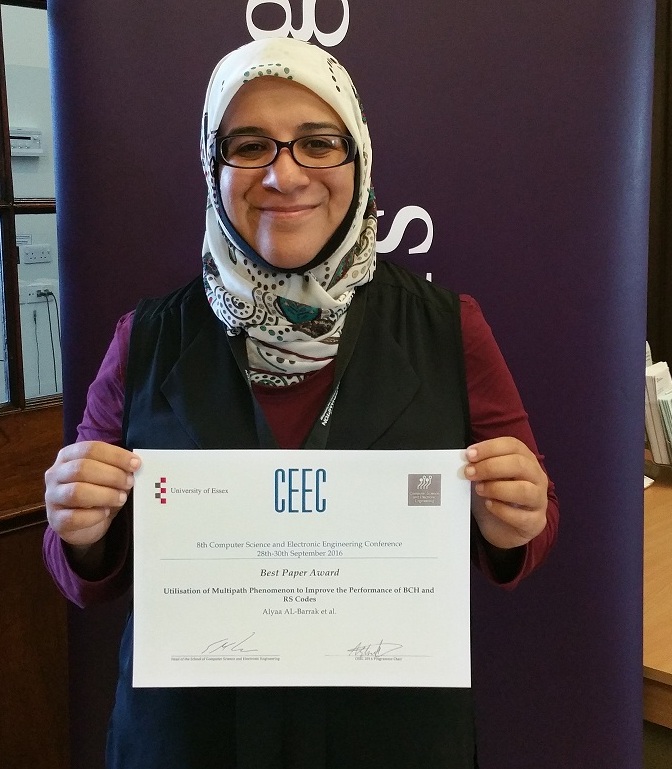
PhD student awarded best paper for her revolutionary research in wireless communication

Taken from: http://www.northampton.ac.uk/news/phd-student-awarded-best-paper-for-her-revolutionary-research-in-wireless-communication/


alyaareresearchpaper2
Not only was PhD student Alyaa Al-Barrak awarded the best paper at a recent conference, she has also had an offer for her paper to be published in a digital library, which hosts documents  from some of the world’s most highly cited publications in the engineering and computer science field.
The eighth Computer Science and Electronic Engineering Conference was held at the University of Essex and is a great opportunity for researchers to meet and network with peers in the same field. Alyaa presented her research paper on wireless communication and the errors that can occur due to noise, reflection, diffraction, shadowing, fading and in particular the multipath phenomenon and the most widely used technique to correct it. Her paper was awarded first place out of 93 other papers, which has led to an inclusion in the Institute of Electrical and Electronics Engineers’ Xplore Digital Library and an offer to publish an extended paper in a journal.
Alyaa said: “I was so pleased to be awarded the best paper at the conference and consider this a great achievement which has encouraged me to go further in this field. It has also provided me with evidence that I am delivering high-quality research and it will be a great addition to my CV.”
Robin Crockett, Alyaa’s Director of Studies, said: “Alyaa’s supervisors, Ali Al-Sherbaz, Triantafyllos Kanakis and myself are immensely proud of Alyaa. This is a major achievement and major recognition of Alyaa’s work from other researchers in the field of digital communications.”
Triantafyllos Kanakis, Lecturer in Computing, commented: “The solution proposed in this paper is revolutionary, drastically increasing the overall performance of a wireless system while saving expensive channel resources from retransmission.”
Ali Al-Shabaz, Senior Lecturer in Computing, commented: “The research outcomes of this work will have an impact on future technology and smart applications. The next stage of Alyaa’s research is expected to find more interesting results which will be worthy of publication in a journal with a high impact factor.”


All views and opinions are the author's and do not necessarily reflected those of any organisation they are associated with. Twitter: @scottturneruon
Tuesday, 23 August 2016

Utilisation of multipath phenomenon to improve the performance of BCH and RS codes

Al Barrak, A.Al-Sherbaz, A.Kanakis, T. and Crockett, R. G. M. (2016) Utilisation of multipath phenomenon to improve the performance of BCH and RS codes. In: 8th Computer Science and Electronic Engineering Conference. New York: IEEE. (Accepted)


Abstract

In wireless communication, there exists a phenomenon known as ‘multipath’. This phenomenon is considered as a disadvantage because it causes interference. The multipath phenomenon results in an antenna receiving two or more signals from the same sent signal from different paths. This paper considers them as redundant copies of the transmitted data and utilises them to improve the performance of forward error correction (FEC) codes without extra redundancy, in order to improve data transmission reliability and increase the bit rate over wireless communication channels. The system was evaluated in bit error rate (BER) and used Bose, Ray-Chaudhuri and Hocquenghem (BCH) and Reed-Solomon (RS) codes as FEC. The results showed that the utilisation of the multipath improves the performance of FEC. Furthermore, the performance of FEC codes had t1 error correction capability and employed the multipath is better than FEC codes have t2 error correction capability and without the multipath, where t1 < t2. Consequently, the bit rate is increased, and communication reliability is improved without extra redundancy.
To find out go to http://nectar.northampton.ac.uk/8666/


If you'd like to find out more about Computing at the University of Northampton go to: www.computing.northampton.ac.uk. All views and opinions are the author's and do not necessarily reflected those of any organisation they are associated with