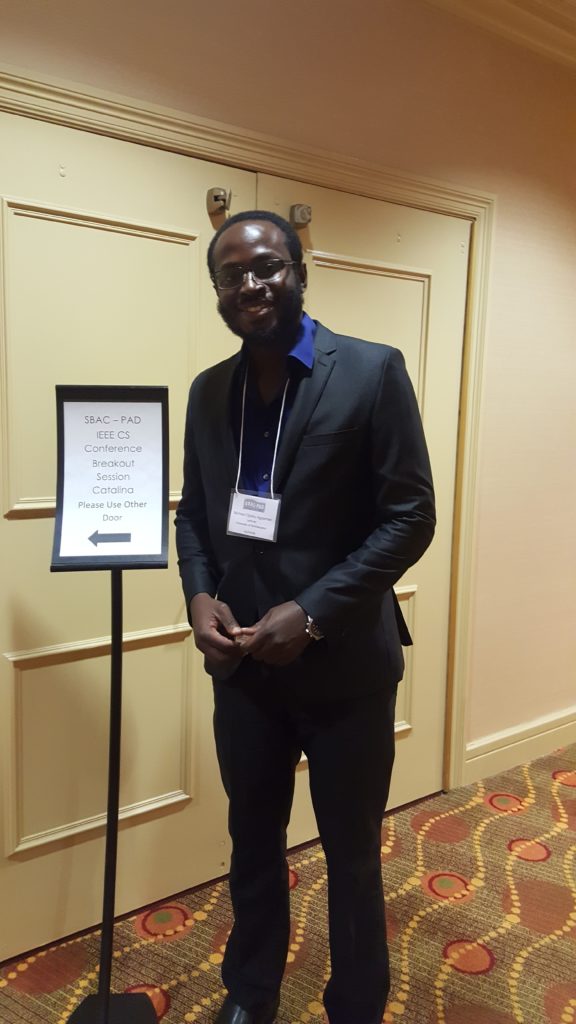
The combination of an MSc Computing student and a Computing Lecturer again leads to publishing success. A paper on the security in Internet of Things (IoT) has recently been accepted for publication.
Dean, A. and Opoku Agyeman, M. (2018) A study of the advances in IoT security. In: International Symposium on Computer Science and Intelligent Control. Sweden: ISCSIC.
Abstract
The Internet-of-things (IoT) holds a lot of benefits to our lives by removing menial tasks and improving efficiency of everyday objects. You are trusting your personal data and device control to the manufactures and you may not be aware of how much risk your putting your privacy at by sending your data over the internet. The internet-of-things may not be as secure as you think when the devices used are constrained by a lot of variables which attackers can exploit to gain access to your data / device and anything they connected to and as the internet-of-things is all about connecting devices together one weak point can be all it takes to gain full access. In this paper we have a look at the current advances in IoT security and the most efficient methods to protect IoT devices.
To learn more contact Dr Michael Opoku-Agyeman
All views and opinions are the author's and do not necessarily reflected those of any organisation they are associated with. Twitter: @scottturneruon
Computing within Northamptonshire is dynamic with interests in many aspects of computing and engineering. All views are the author and the site is the property of the author.
Showing posts with label Michael Opoku Agyeman. Show all posts
Sunday, 13 May 2018
Friday, 7 April 2017
An energy-efficient NOMA for small cells in heterogeneous CRAN
Vien, Q.-T., Le, T. A., Phan, C. V. and Opoku Agyeman, M. (2017) An energy-efficient NOMA for small cells in heterogeneous CRAN under QoS constraints. Paper to be presented to: 23rd European Wireless (EW), Dresden, Germany, 17-19 May 2017
Abstract
More details: http://nectar.northampton.ac.uk/9412/
All views and opinions are the author's and do not necessarily reflected those of any organisation they are associated with. Twitter: @scottturneruon
Abstract
This paper investigates downlink performance of wireless backhaul in a heterogeneous cloud radio access net- work (HCRAN) consisting of a cloud-based central station (CCS) and multi-tier small cells. Non-orthogonal multiple access (NOMA) is adopted for the downlink from the CCS to multiple small cells of different types (e.g. microcells, picocells and femtocells). Taking into account practical power consumption at small cells operating within various propagation environment models, we first develop a power allocation for the NOMA, which allows us to derive the energy efficiency (EE) of the wireless backhaul in the practical HCRAN downlink. It is shown that the NOMA is superior to the conventional OFDMA scheme achieving a higher EE of up to six times with the deployment of small cells. The propagation environment is also shown to have a significant impact on the EE performance with a big gap between different cell types when the number of cells is large. Particularly, the EE of the NOMA is shown to not always increase or decrease as a function of the number of cells, while the throughput performance at the cloud edge is strikingly degraded as the number of cells increases. This accordingly motivates us to propose a two-stage algorithm for determining the optimal number of various cells that maximises the EE of the HCRAN while still maintaining the QoS requirement at the cloud edge. Simulation results show that, to meet a target cloud-edge throughput, the same number of femtocells and picocells can be used; however, the femtocells are favourable to the picocells in achieving the maximal EE.
More details: http://nectar.northampton.ac.uk/9412/
All views and opinions are the author's and do not necessarily reflected those of any organisation they are associated with. Twitter: @scottturneruon
Thursday, 24 November 2016
Computer lecturer’s research helps improve the next generation of technology
A computing lecturer at the University of Northampton, who is researching into how the efficiency of our everyday devices, such as mobile phones, can be improved, has been awarded the best paper at two recent conferences.
Dr Michael Opoku Agyeman has written several journal papers focusing on how the next generation of technology can meet the ever increasing demands from consumers. He was invited to present his work at the 19th Euromicro Conference on Digital System Design in Cyprus and the Institute of Electrical and Electronics Engineers’ 14th International Conference in Paris.
Part of his research concentrates on whether several processing elements can be incorporated on a single chip, known as System-On-Chip, to improve the efficiency and speed of the computing systems that we use every day, from mobile phones to video-game consoles and even medical equipment. Usually, metal-based interconnecting wires are used for on-chip communication, but Dr Opoku Agyeman is looking into alternative fabrics, such as three dimensional integrated circuits, millimetre wave and surface wave technologies.
Dr Opoku Agyeman explains: “At the heart of each of the devices we commonly use is the processor which keeps it all running. We now expect more features from smaller devices which provide flexibility and efficiency, as well as longer battery life or some type of energy saving mode. To meet these demands, the next generation of devices will need to incorporate the System-On-Chip element and consequently the architecture and communication design techniques must be developed to improve the effectiveness of our computer systems.
“The System-On-Chip combines several components such as processors, peripherals, memory blocks and power management circuits on a single integrated circuit. One issue in particular that dominates next generation designs arises from the non-scalable wire delays and power consumption of the on-chip communication infrastructure.
“To compensate for the fast-paced technological scalability with the performance bottleneck of conventional metal-based interconnects, I have been involved in researching alternative interconnect fabrics. The highlights of my research have so far included an analytical channel model for wireless System-On-Chip design, for which I was awarded the best paper at the Institute of Electrical and Electronics Engineers’ Conference, along with my international collaborative work resulting in a technique that improves the performance of on-chip networks, which was recognised at the Euromicro Conference.
“It is a great honour to be awarded the best paper for both conferences which are highly prestigious.”
All views and opinions are the author's and do not necessarily reflected those of any organisation they are associated with. Twitter: @scottturneruon
Tuesday, 24 May 2016
University receives over £500,000 worth of technology to enrich students’ learning
Taken from: http://www.northampton.ac.uk/news/500k-technology-donation/
If you'd like to find out more about Computing at the University of Northampton go to: www.computing.northampton.ac.uk. All views and opinions are the author's and do not necessarily reflected those of any organisation they are associated with

Computing students at the University of Northampton are benefiting from more than £550,000 worth of new cutting-edge hardware and software, which has been donated to the institution by leading players in the technology industry.
The hardware kits, which are widely recognised in both industry and academia, will allow University of Northampton students the opportunity to develop their learning at an industry standard – ensuring that once they graduate they leave University with the skills and experience that employers require.
The hardware and software – which is worth collectively over £553,000 – has been donated by three leading computing organisations: Altera (now part of Intel), ARM, and Texas Instruments.
The donated kit includes two different types of circuit boards; one which supports high-intensity computing applications such as cloud computing, data acquisition and network processing, and another which is suitable for a wide range of exercises in courses on digital logic and computer organisation.
The computing software and hardware that have been donated will be used in research projects and group work to provide students with the knowledge required to design an ‘Internet of Things’ system and/or modern embedded systems applications. The ‘Internet of Things’ concept will mean that every device that can ‘power up’ could potentially be controlled from the internet – either from a PC or smart device, or by using Bluetooth technology.
All of the donations will be embedded into the teaching curriculum and used by students studying Computing (Computer Systems Engineering), and those undertaking postgraduate research at the University.
Dr Michael Opoku Agyeman, Lecturer in Computing, explained: “The kits are well equipped with state-of-the-art technology to cover a wide scope of applications in Computer Systems Engineering. Both our undergraduate and postgraduate research students will benefit from rapid prototype and evaluation of basic to advanced digital world projects in game console design, robotics, home and industrial automation, wearable computing, digital signal processing, reconfigurable computing, digital electronic devices and Very-Large-Scale-Integration circuit design.
“Donations such as these support the University’s mission to transform lives and inspire change.”
The University of Northampton’s Computing (Computer Systems Engineering) degree allows students to study the integral role that effective computer systems play in 21st Century society – from local, small scale systems that may be developed by a single person to make their devices interact; through to larger multi-national companies with employees who need to communicate fast and securely.
Find out more Computer Systems Engineering at the University of Northampton. Computer Science at the University was recently ranked 19th in the United Kingdom, in the 2017 Guardian University Guide.
—
Pictured: Dr Michael Opoku Agyeman, with some of the donated technology.
If you'd like to find out more about Computing at the University of Northampton go to: www.computing.northampton.ac.uk. All views and opinions are the author's and do not necessarily reflected those of any organisation they are associated with
Subscribe to:
Posts (Atom)